Executive Overview
Mazda Connect is Mazda’s proprietary in-vehicle infotainment (IVI) and telematics system, designed around a human-centric engineering philosophy (Jinba Ittai). Rather than treating IVI merely as a multimedia interface, Mazda engineered Mazda Connect as a unified hardware and software platform that balances driver engagement, minimal cognitive distraction, and real-time vehicle diagnostics.
This document outlines the core technical framework of Mazda Connect, covering its system architecture, Human-Machine Interface (HMI) design, telematics infrastructure, protocol stacks, and cybersecurity controls.
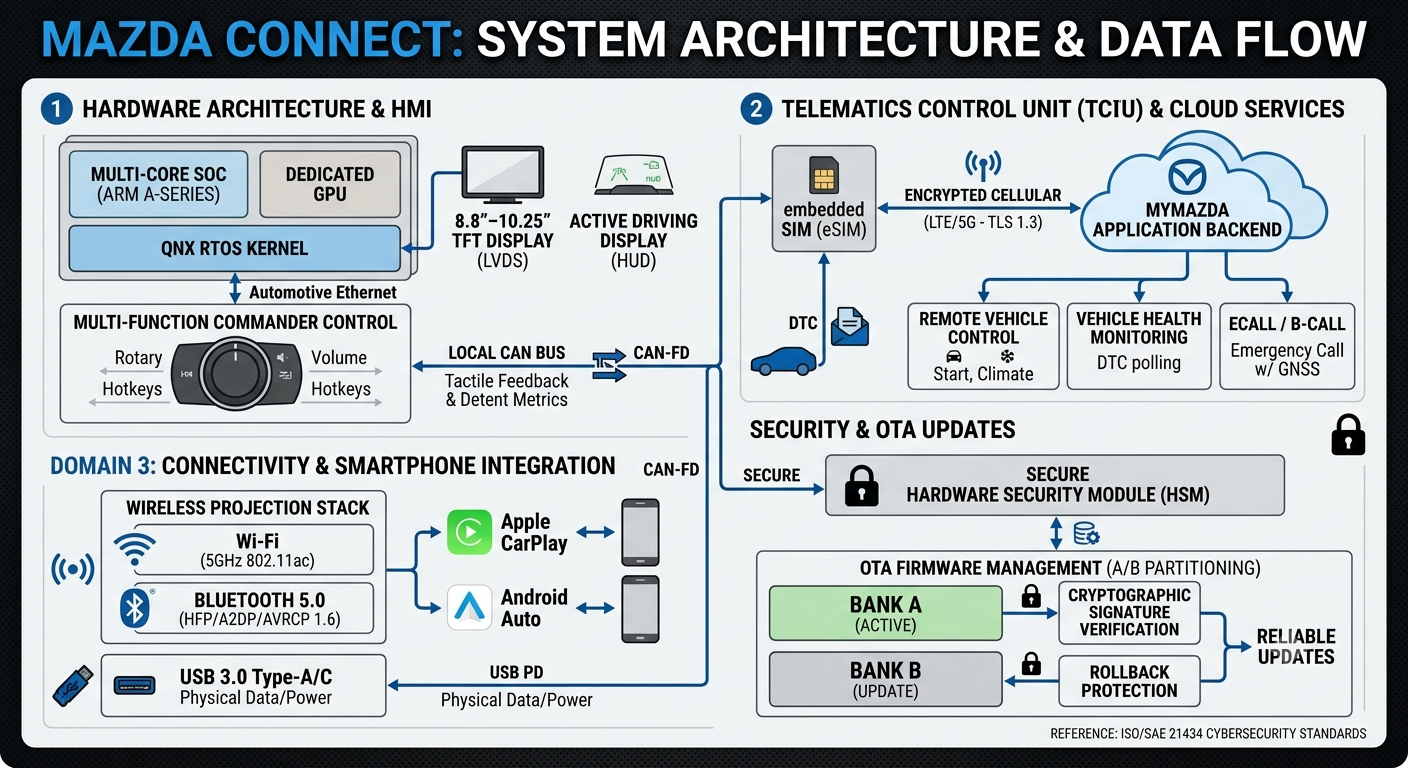
1. Hardware Architecture & Computing Infrastructure
The underlying hardware platform for modern Mazda Connect iterations (particularly the 7th-generation architecture and newer) transitions from legacy Automotive Grade Linux (AGL) / QNX single-board configurations to a robust multi-core System-on-Chip (SoC) environment.
+-----------------------------------------------------------------------+
|                       System-on-Chip (SoC)                            |
|                                                                       |
|   +--------------------------+         +--------------------------+   |
|   |   ARM Cortex-A Series    |         |     Dedicated GPU        |   |
|   |  Multi-Core Processor    |         |  (UI Rendering Pipeline) |   |
|   +------------+-------------+         +------------+-------------+   |
|                |                                    |                 |
+----------------|------------------------------------|-----------------+
                 |                                    |
                 v                                    v
+-----------------------------------------------------------------------+
|                             QNX RTOS                                  |
|               (Real-Time Operating System Layer)                      |
+-----------------------------------------------------------------------+
        |                                                 |
        v                                                 v
+-----------------------+                         +---------------------+
| Automotive Ethernet   |                         |  High-Speed CAN /   |
|   (100/1000BASE-T1)   |                         |   CAN-FD Gateway    |
+-----------------------+                         +---------------------+
SoC and Compute Module
- Processing Core: Multi-core ARM Cortex-A series processors handle compute-intensive applications, including UI rendering, vector mapping, voice recognition algorithms, and local data caching.
- Graphics Processing Unit (GPU): A high-performance automotive-grade GPU manages high-DPI display output at native 60 FPS to ensure fluid menu transitions, minimizing visual lag.
- Operating System (RTOS): The platform runs on a POSIX-compliant QNX Hypervisor or real-time operating system (RTOS) kernel. Critical vehicle functions run in isolated partitions to ensure fault isolation from user-facing media applications.
Display and Output Hardware
- Ultrawide TFT LCD Display: High-resolution display panel (ranging from 8.8-inch to 10.25-inch and larger in modern configurations) mounted high on the dashboard directly in the driver’s natural line of sight.
- Active Driving Display (ADD): Head-Up Display (HUD) projected onto the windshield or combiner glass, driven via dedicated Low-Voltage Differential Signaling (LVDS) lines directly from the IVI domain controller.
2. Human-Machine Interface (HMI) and Ergonomics Engineering
Unlike traditional touchscreen-heavy automotive interfaces, Mazda’s HMI strategy restricts or entirely disables touch interaction while the vehicle is in motion to prevent cognitive load, visual off-road time, and the “flying finger” effect caused by vehicle vibrations.
Multi-Function Commander Control
- Physical Interface: A rotary dial paired with push-button vector inputs, volume knobs, and hotkeys (Home, Nav, Back, Entertainment, Favorites).
- Tactile Feedback: Engineered with specific rotational detents and force feedback metrics, allowing drivers to navigate menus blindly through muscle memory.
- Input Protocol: Commands from the rotary knob are transmitted via local controller area networks directly to the HMI manager process with minimal latency (under 50ms total loop delay).
Menu Navigation and UX Paradigm
- Flat Menu Hierarchy: Direct-action navigation architecture limits menu depth to a maximum of 2–3 levels.
- Typography and Visual Ergonomics: Optimized font kerning, high contrast ratios, and dark-mode-first color palettes reduce pupil adaptation latency during night driving.
3. Connectivity Protocols & Smartphone Integration
Mazda Connect operates as a bridge between the driver’s personal devices, the vehicle’s internal CAN networks, and cloud infrastructure.
| Component / Layer | Interface / Protocol | Primary Function |
| Mobile Integration | Apple CarPlay & Android Auto | Wireless (5GHz Wi-Fi / Bluetooth 5.0) and wired USB projection |
| Physical I/O | USB 3.0 Type-A / Type-C | High-speed data transfer & Power Delivery (PD) |
| In-Vehicle Network | CAN-FD / Automotive Ethernet | Vehicle telemetry, sensor feeds, and audio routing |
| Cellular Gateway | 4G LTE / 5G TCAM Module | E-Call, Over-the-Air (OTA) updates, cloud telemetry |
Wireless Projection Stack
- Bluetooth Protocol Stack: Supports HFP (Hands-Free Profile 1.7), A2DP (Advanced Audio Distribution Profile), and AVRCP (Audio/Video Remote Control Profile 1.6) for metadata display.
- Wi-Fi Module: Dual-band (2.4 GHz / 5 GHz) Wi-Fi IEEE 802.11ac configuration handles high-bandwidth video feed projection for wireless Apple CarPlay and Android Auto.
4. Telematics Architecture & MyMazda Cloud Services
The telematics layer of Mazda Connect connects the vehicle to external service platforms via an onboard Telematics Control Unit (TCU).
[ Vehicle Electronic Control Units (ECUs) ]
                     |
                     v (CAN-FD Bus)
        [ Telematics Control Unit (TCU) ]
                     |
                     v (Encrypted Cellular Link - TLS 1.3)
         [ Secure Cloud Gateway ]
                     |
                     v
        [ MyMazda Application Backend ]
Telematics Control Unit (TCU)
The TCU is an independent ECU featuring an embedded SIM (eSIM) that remains active even when the vehicle ignition is off. It acts as the gateway between internal CAN-FD networks and external cellular networks.
Telematics Functionalities
- Remote Engine Start & Climate Control: Receives authenticated push commands from the MyMazda mobile app via cloud brokers, sending wake-up signals across the powertrain CAN bus.
- Vehicle Health Monitoring: Constantly polls diagnostic trouble codes (DTCs) from the Engine Control Module (ECM), Transmission Control Module (TCM), and Battery Management System (BMS), pushing health alerts to the driver and service network.
- Emergency Call System (eCall / B-Call): Upon airbag deployment, crash sensors trigger an immediate priority alert over the cellular module, transmitting precise GNSS coordinates and telemetry data to emergency response centers.
5. Security Architecture & OTA Updates
Given the bi-directional nature of modern telematics, Mazda Connect integrates strict cybersecurity controls following ISO/SAE 21434 automotive cybersecurity standards.
Over-The-Air (OTA) Firmware Management
- Dual-Bank (A/B) Memory Partitioning: The flash memory is divided into active and secondary banks. Updates are written to the secondary bank in the background while the vehicle is operating normally.
- Rollback Protection: If cryptographic verification fails during flashing or post-boot self-tests detect instability, the system automatically rolls back to the previous stable partition.
- Cryptographic Signing: All update packages are signed using asymmetric cryptography (RSA-4096 / ECC P-256). The onboard bootloader verifies signatures using public keys stored in secure hardware before execution.
In-Vehicle Network Security
- Gateway Firewall: The gateway ECU enforces strict message filtering between the infotainment system and safety-critical vehicle buses (such as brake, steering, and powertrain networks).
- Hardware Security Module (HSM): Encrypted keys, secure boot sequences, and TLS certificates are isolated within dedicated cryptographic hardware modules resistant to physical side-channel attacks.
Also Read: The Evolution of the Modern Trail: A Deep Dive into Spypoint Technology – My Tech Blaze
Source: MAZDA CONNECT