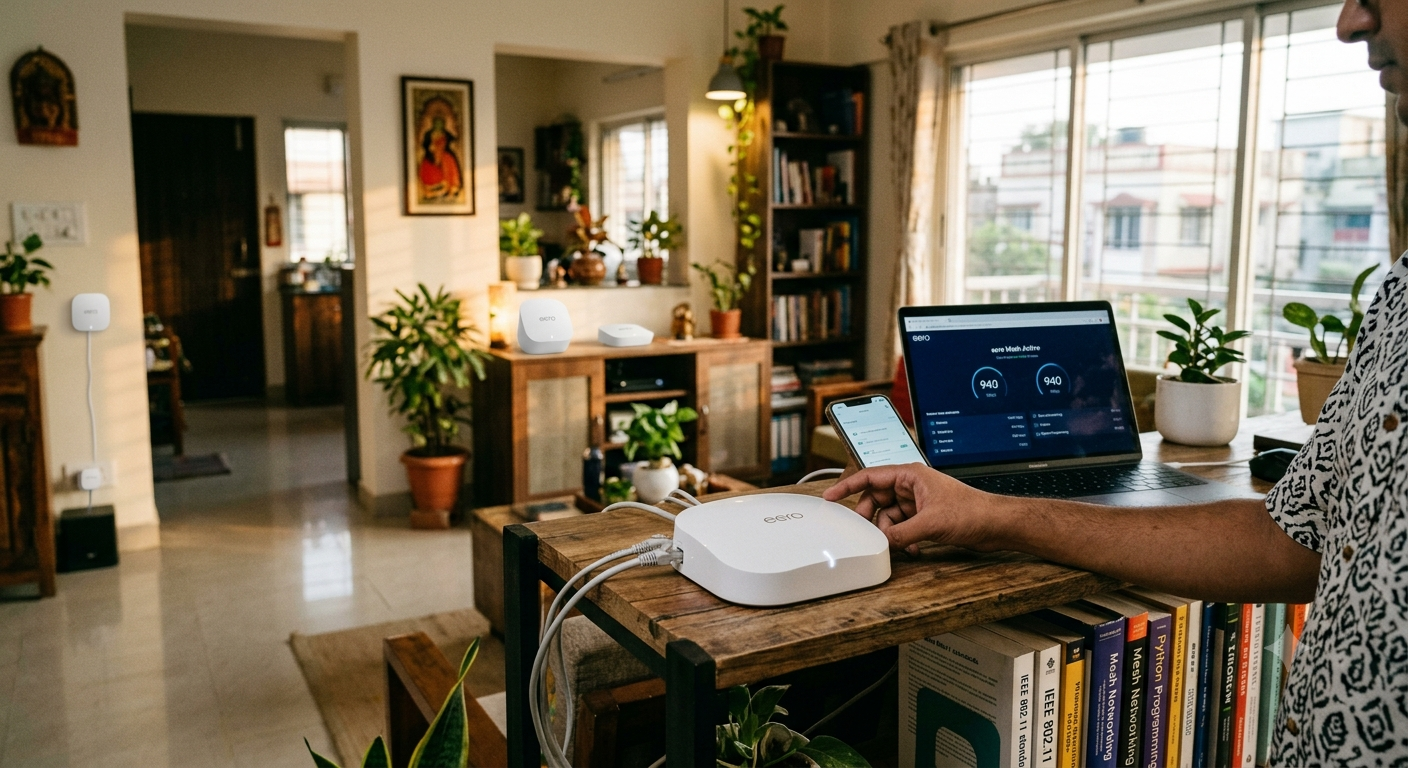
Wireless local area networks (WLANs) have evolved beyond the traditional model of a single high-power access point servicing an entire physical topology. Conventional star-topology networks often struggle with signal attenuation caused by physical barriers, electromagnetic interference, and range-dependent path loss.
To resolve these physical-layer constraints, modern distributed architectures—specifically mesh wireless networks popularized by systems like eero (commonly misspelled as Euro)—utilize decentralized, multi-node dynamic topologies. This technical overview explores the dynamic routing protocols, radio frequency (RF) operational frameworks, embedded system hardware, and security paradigms underlying mesh routers.
Dynamic Mesh Topology & Intelligent Routing Algorithms
At the core of an eero mesh network is a peer-to-peer topology where each node acts as both a local access point (AP) and a network packet router. Traditional Wi-Fi range extenders simply re-transmit frames at the MAC layer, effectively cutting available airtime in half per hop. In contrast, true mesh systems employ dynamic routing protocols to evaluate channel quality and route network traffic efficiently.
       [ Fiber / Cable Modem ]
                  │ (Gigabit/Multi-Gig WAN)
                  ▼
         [ Gateway eero Node ]
            /           \
   (5 GHz / 6 GHz)   (5 GHz / 6 GHz)
          /               \
         ▼                 ▼
  [ Leaf Node 1 ] ◄──────► [ Leaf Node 2 ]
    (Client Dynamic Mesh Multi-Hop)
The primary routing intelligence in these platforms relies on specialized, dynamic path-selection software (e.g., eero’s TrueMesh). This protocol functions dynamically above the datalink layer, drawing inspiration from hybrid routing protocols like Hybrid Wireless Mesh Protocol (HWMP, IEEE 802.11s) and Ad Hoc On-Demand Distance Vector (AODV) routing:
- Metric Path Evaluation: Rather than relying purely on hop counts, the system computes path cost based on packet loss rates, latency variations, signal strength (RSSI), and real-time channel utilization.
- Dynamic Re-routing: If a specific frequency band encounters localized radio frequency interference (e.g., radar signatures, microwave noise, or neighbor network overlapping), the dynamic routing engine updates its routing tables in real time to steer traffic around the degradation point without severing active TCP sessions.
- Seamless Client Roaming: Using 802.11k (Neighbor Reports) and 802.11v (BSS Transition Management), client devices are guided to roam to the optimal node without requiring manual disconnection and reconnection.
Radio Frequency Architecture & Band Optimization
Modern mesh nodes utilize multi-band wireless radios operating simultaneously across the 2.4 GHz, 5 GHz, and 6 GHz ISM bands.
| Wireless Standard | Frequency Bands | Bandwidth & Modulation | Primary Functional Domain |
| Wi-Fi 6 (802.11ax) | 2.4 GHz / 5 GHz | Up to 160 MHz, 1024-QAM | Legacy client handling & mid-range coverage |
| Wi-Fi 6E (802.11ax) | 2.4 GHz / 5 GHz / 6 GHz | Up to 160 MHz, 1024-QAM | High-speed wireless backhaul & 6 GHz clients |
| Wi-Fi 7 (802.11be) | 2.4 GHz / 5 GHz / 6 GHz | Up to 320 MHz, 4096-QAM | Multi-Gigabit backhaul & Multi-Link Operation (MLO) |
Dynamic Backhaul Management
Traditional dual-band mesh systems allocate a static percentage of airtime for node-to-node communications (backhaul). Advanced tri-band and quad-band mesh systems use Dynamic Backhaul, dynamically choosing the best combination of bands and channels for inter-node communication based on live traffic demands and environmental noise floors.
Under Wi-Fi 7 implementations, Multi-Link Operation (MLO) allows a client node to aggregate or instantly failover across multiple distinct frequency bands simultaneously, mitigating the latency spikes associated with single-band wireless transmission.
Smart Home Protocol Integration
Beyond IP-based packet switching over 802.11, modern mesh access points integrate dedicated low-power wireless SoCs to handle smart home automation protocols directly:
- Zigbee (802.15.4): Operates in the 2.4 GHz spectrum using low-power mesh topology for sensors and smart appliances.
- Thread Protocol: A low-power, IP-addressable mesh network protocol running over 802.15.4, providing native IPv6 routing to edge devices.
- Matter Standard: An application-layer connectivity standard built on top of IPv6 (utilizing both Wi-Fi and Thread transports) that standardizes local device control without requiring proprietary cloud bridges.
Integrating Thread border routers directly into mesh access points eliminates the single-point-of-failure drawback inherent in legacy hub-and-spoke smart home configurations.
Hardware Architecture & Embedded Linux Stack
To process multi-gigabit routing tables, deep packet inspection (DPI), and concurrent wireless radios without thermal throttling, mesh nodes rely on enterprise-grade system-on-chip (SoC) architectures.
       ┌─────────────────────────────────────────────────┐
       │             System-on-Chip (SoC)                │
       │    (Multi-Core ARM Cortex-A53 / A73 CPUs)       │
       └────────┬───────────────────────────────┬────────┘
                │                               │
   ┌────────────▼─────────────┐   ┌─────────────▼────────────┐
   │    RAM & Flash Memory    │   │ Wireless MAC/Phy Radios  │
   │  (1-2 GB DDR4 / 4 GB NV) │   │ (2.4 GHz, 5 GHz, 6 GHz) │
   └──────────────────────────┘   └─────────────┬────────────┘
                │                               │
   ┌────────────▼─────────────┐                 │
   │ Multi-Gig Switch Engine  │ ◄─────────────────┘
   │  (2.5G / 5G / 10G Base-T)│
   └──────────────────────────┘
Hardware Specification Highlights
- Processing Units: Multi-core ARM Cortex Processors optimized for network packet offloading and IPsec/TLS hardware acceleration.
- Memory Footprint: Typically equipped with 512 MB to 2 GB of RAM and up to 4 GB of eMMC flash storage to maintain OS redundancy (A/B system partitions).
- Physical Connectivity: Multi-Gigabit Ethernet ports (2.5 GbE, 5 GbE, or 10 GbE) equipped with auto-sensing WAN/LAN capabilities and Power over Ethernet (PoE/802.3at/bt) support on specialized models.
Embedded OS Stack (eeroOS)
The underlying operating system runs a customized, highly secured embedded Linux distribution (often built on Yocto/OpenWrt frameworks). Key low-level functions include:
- Bufferbloat Prevention: Implements Active Queue Management (AQM) such as CAKE or FQ-CoDel to prioritize latency-sensitive traffic (VoIP, video calls, gaming) over high-throughput background downloads.
- Zero-Touch Firmware Maintenance: Automatically performs atomic Over-The-Air (OTA) updates using dual boot partitions to protect against firmware corruption.
Network Security & Cryptographic Standards
Security within modern distributed mesh networks operates on both the local wireless transmission level and the management plane level:
- WPA3 Authentication: Enforces Wi-Fi Protected Access 3 across all bands, replacing the vulnerable Pre-Shared Key (PSK) handshake with Simultaneous Authentication of Equals (SAE) to mitigate offline dictionary attacks.
- Isolated Transport Layer: Management frames exchanged between mesh nodes are encapsulated within encrypted TLS/DTLS tunnels, protecting inter-node discovery protocols.
- Network Isolation: Micro-segmentation separates standard LAN traffic, isolated Guest Networks, and IoT device traffic into isolated VLANs at the kernel level.
Distributed mesh platforms represent a fundamental shift from static hardware configurations to dynamic, software-defined local networking—combining predictive path selection, multi-radio optimization, and edge security protocols to maintain performance across complex environments.
Also Read: The Evolution of the Modern Trail: A Deep Dive into Spypoint Technology – My Tech Blaze
Source: eero: The way wifi should be