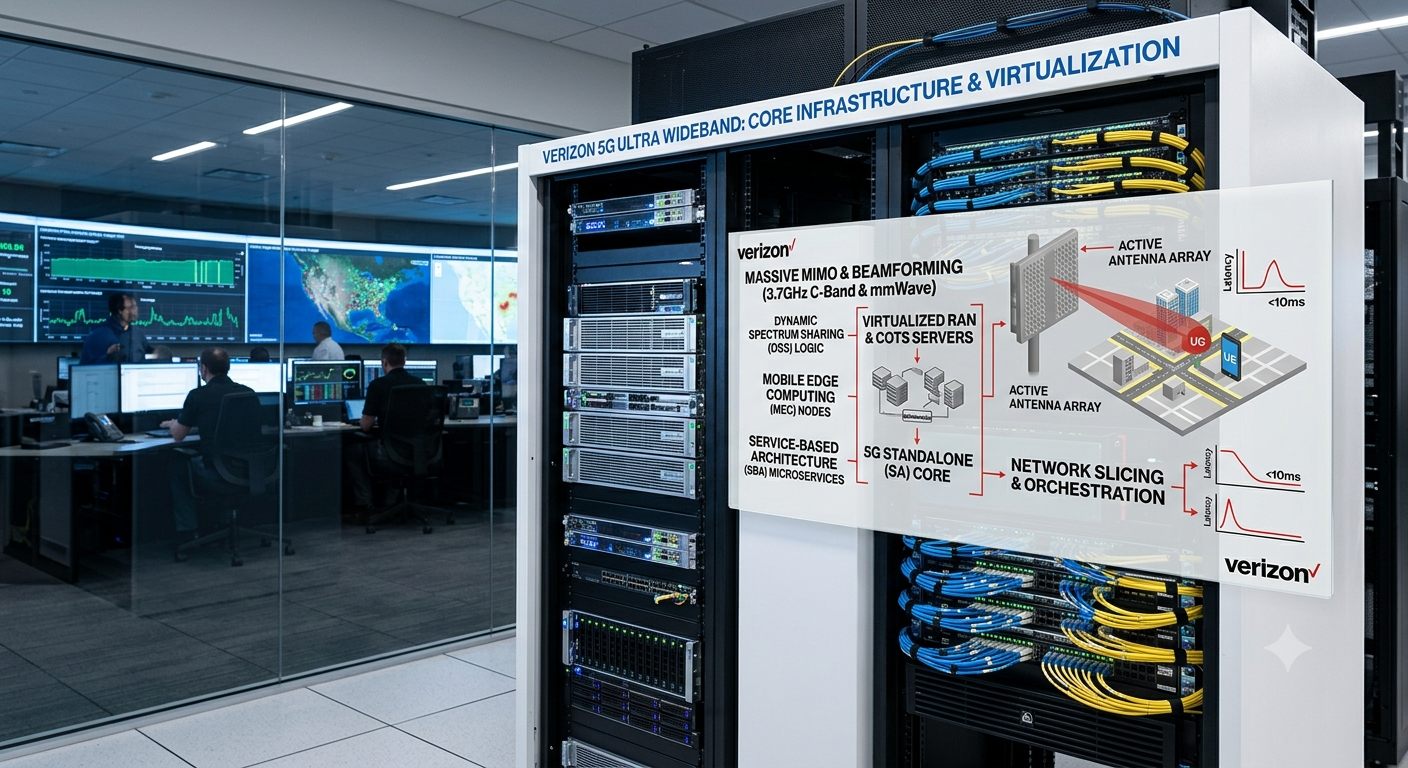
Modern telecommunications networks require a highly coordinated balance of radio frequency engineering, software-defined core systems, and edge routing logic. Verizon’s modern network deployment is anchored heavily by its 5G Ultra Wideband (UW) framework, supported by a massive terrestrial fiber-optic transport web. To understand how the network processes gigabits of telemetry at sub-millisecond speeds, one must dissect the layers of radio spectrum utilization, core virtualization, edge distribution, and cloud orchestration.
1. The Multi-Tier Radio Access Network (RAN) Architecture
The foundational tier of the network is the Radio Access Network (RAN), the physical layer responsible for transceiving signals between user equipment (UE) like smartphones and cell towers. Verizon organizes its cellular architecture across three specific frequency bands to balance range against data throughput:
- Low-Band Spectrum (Sub-2 GHz): Operating primarily on the 700 MHz and 850 MHz bands, this tier serves as the long-range coverage baseline. It utilizes Dynamic Spectrum Sharing (DSS), an algorithmic scheduling technique that dynamically allocates identical spectrum blocks between legacy 4G LTE and 5G signals frame-by-frame based on real-time traffic demand.
- Mid-Band Spectrum (C-Band, 3.7–3.98 GHz): This acts as the high-capacity driver for broad deployments. C-band spectrum provides the sweet spot for network expansion, carrying massive data payloads across broader geographical footprints than higher frequencies could manage alone.
- High-Band Spectrum (mmWave, 28 GHz and 39 GHz): Serving high-density zones like stadiums and urban thoroughfares, millimeter-wave (mmWave) deployments unlock high-frequency channels capable of multi-gigabit speeds. However, these waves suffer from high atmospheric attenuation (signal degradation over distance) and poor structural penetration, requiring a dense grid of small-cell nodes.
To maximize the efficiency of these bands, Verizon deploys Massive MIMO (Multiple-Input Multiple-Output) antenna arrays. Instead of broadcasting a single omnidirectional wave, these arrays leverage beamforming—a process where phase shifters adjust the phase and amplitude of multiple radiating elements. This causes constructive interference along a precise path, focusing a targeted RF beam directly at an active device to reduce interference and boost throughput.
2. Transitioning to the 5G Standalone (SA) Core
While early 5G deployments relied on Non-Standalone (NSA) architectures where the 5G radio signals were still anchored to a legacy 4G Evolved Packet Core (EPC), Verizon continues its transition to a pure 5G Standalone (SA) Core. The SA core shifts the entire routing backend away from specialized hardware to a fully cloud-native, containerized architecture.
The backbone of this SA core is the Service-Based Architecture (SBA). In this environment, network operations are broken down into self-contained, microservice-like Network Functions (NFs) that communicate via standardized HTTP/2 RESTful APIs. Key NFs include:
- AMF (Access and Mobility Management Function): Handles UE registration, authentication, and mobility management across gNodeB (5G base station) handoffs.
- SMF (Session Management Function): Manages IP address allocation and controls the user plane path, establishing session continuity.
- UPF (User Plane Function): The critical data-routing pipeline. By decoupling the UPF (the data path) from the AMF and SMF (the control plane), network engineers can push the actual processing of raw data packets out to regional data centers closer to the edge, drastically slashing round-trip latency.
3. Network Slicing and Mobile Edge Computing (MEC)
The true operational capability unlocked by a cloud-native 5G SA core is end-to-end network slicing. This architectural paradigm uses software-defined networking (SDN) and network functions virtualization (NFV) to carve out discrete, virtual networks over the same physical hardware.
Each network slice can be configured with its own strict Quality of Service (QoS) metrics. For instance, a slice dedicated to autonomous driving systems can be engineered for Ultra-Reliable Low-Latency Communication (URLLC), reserving dedicated bandwidth and priority scheduling at the physical layer. Conversely, a slice for massive Internet of Things (mIoT) telemetry can prioritize high device density and low energy consumption, allowing data drops without compromising premium voice or enterprise traffic.
To ground this low-latency data flow, Verizon implements Mobile Edge Computing (MEC) topologies. By embedding public cloud nodes (such as AWS Wavelength, Microsoft Azure, and Google Cloud) directly within Verizon’s local routing facilities, data packets bypass the public internet entirely. A packet traveling from a device hits the cell tower, routes through the localized UPF, and is immediately processed by an edge server just miles away, driving latency values down under 10 milliseconds.
4. Hardware Virtualization and Open RAN (O-RAN)
Historically, telecommunications infrastructure was built out of proprietary, tightly coupled hardware stacks from a single vendor. Verizon’s ongoing modern evolution relies on decoupling the software from the physical layer via Virtualized RAN (vRAN) and Open RAN principles.
In a traditional setup, baseband processing happened directly at the tower site inside proprietary baseband units (BBUs). Verizon’s vRAN model virtualizes these workloads, shifting them to commercial off-the-shelf (COTS) x86 servers running containerized software. The baseband functionality is split into two components:
- Distributed Units (DUs): Located close to or at the cell sites to handle real-time physical layer processes like scheduling and channel coding.
- Centralized Units (CUs): Positioned further upstream in regional hubs to manage non-real-time packet processing and protocol translation.
By embracing Open RAN technical standards, Verizon ensures that the interfaces between the Radio Unit (RU) at the top of the tower, the DU, and the CU are fully interoperable. This prevents vendor lock-in and allows software patches to update network capabilities globally, accelerating the roll-out of advanced security layers and protocol enhancements.
5. The Fiber Backhaul and Fixed Wireless Access Engine
Radio waves are only as fast as the terrestrial cables backing them up. Verizon’s multi-year investment in deploying hundreds of thousands of fiber strand miles acts as the transmission foundation for its wireless network.
The backhaul network relies heavily on Wavelength Division Multiplexing (WDM). By sending multiple laser beams of varying wavelengths (colors) down a single optical fiber strand, the network moves tens of terabits of aggregated cell-site traffic back into core routing centers simultaneously.
This deep optical penetration also powers Verizon’s Fixed Wireless Access (FWA) platform. Rather than pulling glass fibers directly into a residential or enterprise structure, the last-mile delivery is achieved via point-to-multipoint mid-band or mmWave 5G links. At the customer site, an indoor or outdoor receiver translates the incoming directional RF beam back into standard copper Ethernet or Wi-Fi routing signals, proving that modern network architecture is a seamless synthesis of wireless agility and wired capability.
Also Read: Express VPN Service For Fast And Secure Internet Browsing – My Tech Blaze
Source:Verizon: Wireless, Internet, TV and Phone Services | Official Site