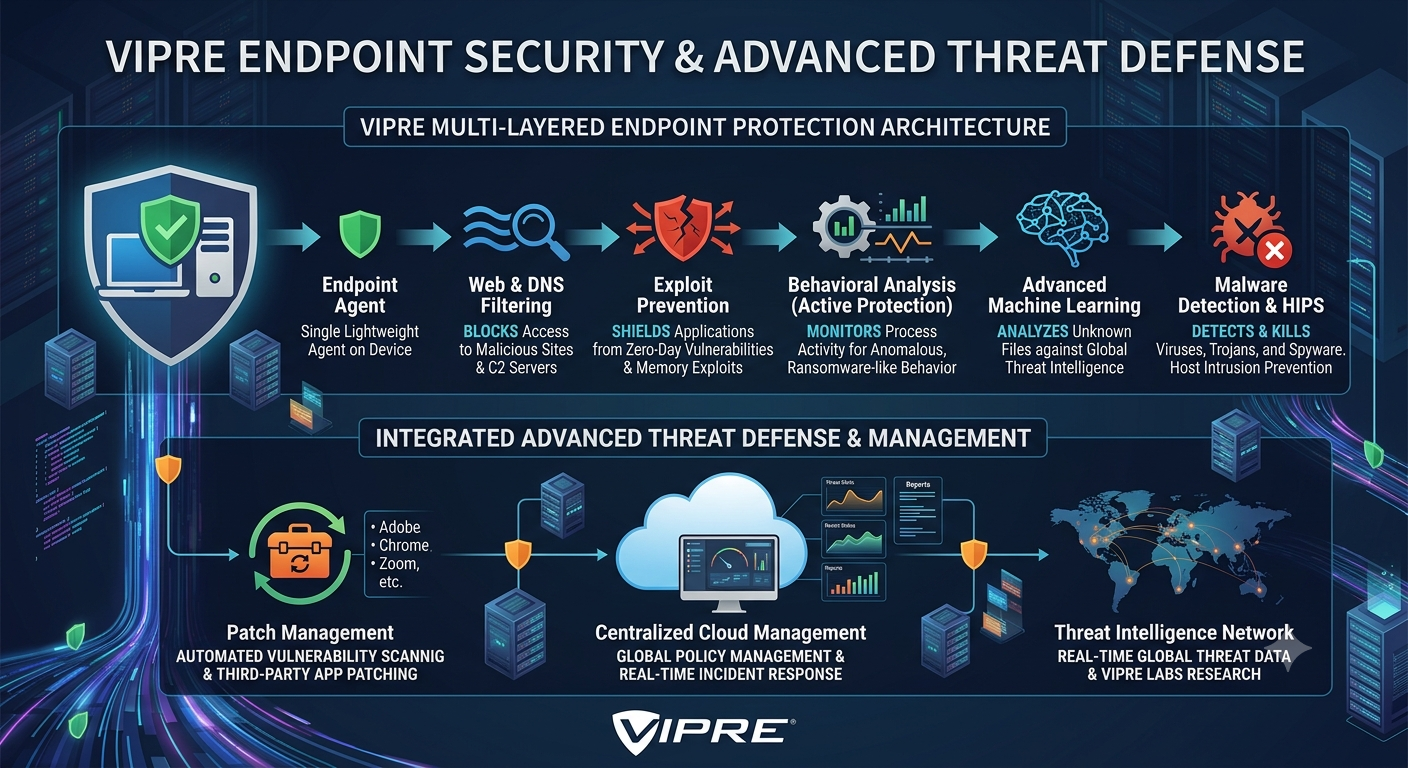
In the modern enterprise security landscape, the endpoint is the primary battleground. Adversaries no longer just break in; they log in using compromised credentials, exploit zero-day vulnerabilities, or deploy polymorphic ransomware that evades traditional signature-based antivirus (AV) solutions.
VIPRE Security Group addresses this attack surface through a multi-layered, cloud-managed endpoint protection platform (EPP) integrated with advanced threat intelligence and detection capabilities. This technical analysis explores the core architecture, detection engines, network defense mechanisms, and operational workflows of VIPRE Endpoint Security.
1. Multi-Layered Detection Engine Architecture
VIPRE’s endpoint agent abandons the legacy approach of relying solely on static signature matching. Instead, it implements a defense-in-depth architecture that analyzes file characteristics, execution behaviors, and memory states simultaneously.
[Inbound File/Process]
          │
          ├──> 1. Static Signature & Heuristic Analysis (Known Threats)
          │
          ├──> 2. Machine Learning / Advanced Behavioral Analysis (Polymorphic Media)
          │
          └──> 3. Exploit Prevention & Memory Protection (In-Memory Attacks)
Static and Heuristic Analysis
At the foundational layer, VIPRE utilizes high-performance signature matching alongside advanced heuristics. While signatures handle known malicious hashes efficiently, the heuristic engine looks for code structures and characteristics common to malware families. This allows the agent to intercept variants of known threats without requiring an exact signature match.
Machine Learning and Behavioral Analysis
For unknown or zero-day threats, VIPRE integrates cloud-driven and local machine learning models. The behavioral analysis engine monitors running processes in real time, looking for anomalous sequences of actions. Examples include:
- Rapid, unauthorized modification of file extensions (indicative of ransomware).
- Unusual process injection attempts (e.g.,
svchost.exespawning an unrecognized binary). - Modifications to critical system registry hives or boot configurations.
If a process exhibits a high-confidence threshold of malicious behavior, VIPRE automatically terminates the process tree and isolates the affected file.
Exploit Prevention and Memory Protection
Modern attackers frequently leverage fileless malware and living-off-the-land (LotL) techniques, executing malicious scripts directly in memory via legitimate utilities like PowerShell, WMI, or command prompts. VIPRE’s Exploit Prevention layer monitors memory space allocated to common applications (such as web browsers, Adobe Reader, and Microsoft Office). It detects and blocks common exploitation techniques, including:
- Return-Oriented Programming (ROP) chains
- Buffer overflows
- API hooking attempts designed to bypass Windows API monitoring
2. Network-Layer Defense and Web Filtering
Endpoint security cannot stop at the file system; it must extend to the network interface. VIPRE integrates a two-way firewall and malicious URL filtering directly into its endpoint agent.
Malicious URL and Phishing Filtering
VIPRE intercept HTTP and HTTPS traffic at the network stack level. By leveraging global threat intelligence networks, it cross-references requested domains and IP addresses against a continuously updated database of known malicious command-and-control (C2) servers, phishing sites, and exploit kits. If a user clicks a malicious link or an application attempts to phone home to a C2 server, the connection is dropped before the payload can be delivered.
DNS-Layer Protection
By inspecting and filtering DNS requests, VIPRE prevents endpoints from resolving domains associated with malicious actors. This proves highly effective against domain generation algorithms (DGAs) commonly utilized by advanced persistent threats (APTs) to maintain persistence within a compromised network.
3. Vulnerability Assessment and Patch Management
One of the most effective ways to reduce an organization’s attack surface is closing the window of vulnerability between a patch release and its deployment. VIPRE integrates automated vulnerability scanning and patch management directly into its central management console.
Automated Third-Party Patching
While operating systems like Windows have built-in update mechanisms, third-party applications (e.g., Google Chrome, Zoom, Adobe Creative Cloud) are frequently left unpatched, leaving open doors for attackers. VIPRE continuously scans endpoints for outdated software versions, correlates them with known Common Vulnerabilities and Exposures (CVEs), and pushes updates silently to the endpoints without requiring user intervention or massive bandwidth consumption.
4. Threat Intelligence and Centralized Management
The efficacy of an endpoint solution is heavily dependent on the telemetry it consumes and the ease with which security administrators can orchestrate responses.
VIPRE ThreatAnalyzer and Cloud Intelligence
VIPRE endpoints act as distributed sensors. When an unknown, suspicious file is encountered, its metadata and behavior can be securely analyzed via VIPRE’s cloud-based sandbox environments (ThreatAnalyzer). This sandbox detonates the file in a controlled virtual environment, observing its full execution path, registry modifications, and network callouts. The resulting intelligence is fed back into the global VIPRE network, immunizing all other deployed endpoints within minutes.
Centralized Management Console
From a single pane of glass, administrators can deploy agents, configure granular security policies, and review threat alerts. The platform provides:
- Role-Based Access Control (RBAC): Restricting console capabilities based on administrative roles.
- Dynamic Policy Assignment: Tailoring security strictness based on device types or user groups (e.g., stricter policies for remote laptops vs. isolated internal servers).
- Real-Time Remediation: Initiating manual or automated scans, isolating compromised endpoints from the local network while maintaining a connection to the management console, and rolling back malicious changes.
| Feature Component | Primary Defense Mechanism | Impact on Endpoint Security |
| Advanced Behavioral Analysis | Real-time process monitoring | Blocks zero-day and polymorphic ransomware threats. |
| Exploit Prevention | Memory monitoring and ROP chain blocking | Prevents fileless attacks targeting legitimate applications. |
| Web & DNS Filtering | Network stack interception | Cuts off C2 communications and stops drive-by downloads. |
| Integrated Patch Management | Automated CVE scanning and third-party deployment | Closes software vulnerabilities before they are exploited. |
5. Architectural Efficiency and Performance
A common pitfall of enterprise EPP solutions is resource exhaustion. Security agents that saturate CPU cores and exhaust RAM often lead to end-users disabling protection or suffering severe productivity losses.
VIPRE is architected with a low-footprint design. By utilizing a single agent architecture, it minimizes kernel-driver overhead. The scanning engine optimizes resource consumption by skipping previously verified, unmodified files (using smart caching mechanisms) and deferring heavy analytical tasks—such as deep sandboxing—to the cloud whenever possible. This ensures that endpoint protection remains unobtrusive while maintaining a rigorous security posture.
Also Read: The Ultimate Guide to Modern Cybersecurity: Demystifying Malwarebytes – My Tech Blaze
Source: Comprehensive Cybersecurity for Business and Home | VIPRE