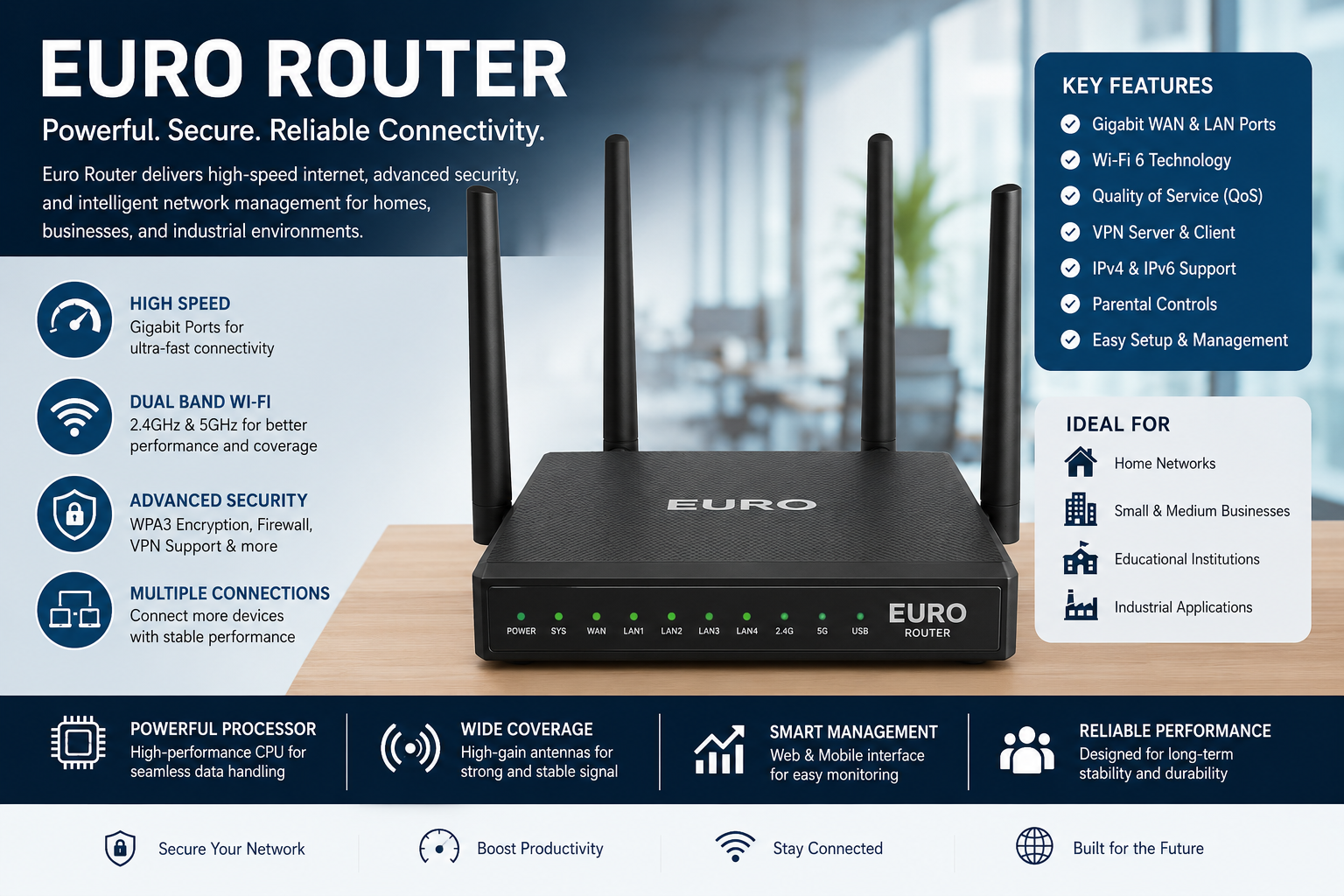
As businesses and homes become increasingly dependent on digital communication, the demand for reliable networking equipment continues to grow. Whether it is cloud computing, remote work, video conferencing, industrial automation, or smart home applications, a stable internet connection is essential. At the heart of every efficient network lies a high-performance router. A Euro Router is designed to deliver secure, fast, and intelligent network connectivity while supporting modern communication standards. With advanced routing capabilities, robust security features, and efficient traffic management, Euro Routers are widely used across residential, commercial, and industrial environments.
Understanding a Euro Router
A Euro Router is a networking device that directs data traffic between different networks. It connects multiple devices, such as computers, smartphones, printers, IP cameras, and servers, to the internet while ensuring that data packets reach their intended destination efficiently. Unlike a simple network switch, a router analyzes network traffic and determines the most effective path for data transmission using routing protocols and routing tables.
Modern Euro Routers are equipped with advanced processors, high-speed Ethernet interfaces, dual-band or tri-band wireless technology, VPN support, and enterprise-level security features. These capabilities make them suitable for handling large volumes of network traffic while maintaining consistent performance and minimal latency.
How a Euro Router Functions
The primary role of a Euro Router is to receive internet data from an Internet Service Provider (ISP) through a modem or dedicated WAN connection and distribute that data across connected devices. Every device on the local network is assigned a unique IP address, allowing the router to identify where incoming and outgoing data should be sent.
When a user accesses a website, sends an email, or streams a video, the router examines the destination IP address and forwards the data through the most efficient route. It continuously updates routing information to optimize communication and reduce delays.
In addition to routing internet traffic, Euro Routers perform several critical networking functions, including:
- Network Address Translation (NAT)
- Dynamic Host Configuration Protocol (DHCP)
- Firewall protection
- Wireless signal broadcasting
- Bandwidth management
- Virtual Local Area Network (VLAN) support
- Virtual Private Network (VPN) connectivity
These features contribute to improved network efficiency and security.
Key Technical Features
One of the most significant advantages of a Euro Router is its combination of performance and security. Modern models are equipped with features that meet the networking requirements of today’s connected environments.
High-Speed Connectivity
Euro Routers support Gigabit and Multi-Gigabit Ethernet interfaces, allowing users to maximize the performance of fiber broadband and high-speed internet services. Many models also support Wi-Fi 6 and Wi-Fi 6E, providing higher throughput, lower latency, and better performance in crowded wireless environments.
Advanced Wireless Technology
Modern wireless standards improve both speed and efficiency. Technologies such as OFDMA, MU-MIMO, and Beamforming enable multiple devices to communicate simultaneously while maintaining strong wireless coverage throughout homes and offices.
Intelligent Quality of Service (QoS)
Quality of Service prioritizes network traffic based on application requirements. Critical services like VoIP calls, online meetings, video streaming, and cloud applications receive higher priority than background downloads, ensuring uninterrupted performance.
Comprehensive Security
Cybersecurity is an essential component of any modern network. Euro Routers integrate multiple security mechanisms, including:
- Stateful Packet Inspection (SPI)
- Network Address Translation (NAT)
- WPA3 wireless encryption
- Firewall protection
- VPN server and client support
- MAC address filtering
- Intrusion detection systems
- Access control policies
These features help safeguard confidential information and prevent unauthorized access to the network.
Benefits of Using a Euro Router
A Euro Router offers several operational and technical advantages that improve both user experience and network reliability.
One major benefit is stable internet connectivity. Advanced routing algorithms reduce packet loss and network congestion, ensuring consistent performance even when many devices are connected simultaneously.
Another advantage is improved security. Built-in firewalls, encrypted wireless communication, and VPN functionality create a secure networking environment suitable for businesses handling sensitive information.
Euro Routers also provide excellent scalability. As organizations expand, additional switches, wireless access points, and network devices can be integrated without replacing the existing router.
Many models include centralized management interfaces that allow administrators to monitor bandwidth usage, configure security settings, perform firmware updates, and troubleshoot network issues remotely.
Applications Across Industries
Euro Routers are designed for a wide range of networking applications.
Residential Networks
Home users rely on Euro Routers to connect laptops, smartphones, gaming consoles, smart TVs, security cameras, and IoT devices. Dual-band and tri-band wireless connectivity ensures stable internet access throughout the home.
Business Environments
Small and medium-sized businesses use Euro Routers to support cloud-based applications, remote employees, online collaboration tools, and secure communication between branch offices.
Enterprise Networks
Large organizations deploy Euro Routers to manage multiple office locations, establish VPN tunnels, optimize traffic flow, and provide secure internet access to hundreds of users simultaneously.
Educational Institutions
Schools, colleges, and universities depend on high-capacity routers for digital classrooms, online learning platforms, examination systems, and campus-wide wireless connectivity.
Industrial Automation
Manufacturing plants utilize industrial-grade Euro Routers for machine communication, Industrial Internet of Things (IIoT), Supervisory Control and Data Acquisition (SCADA) systems, and remote equipment monitoring.
Network Protocol Compatibility
A technically advanced Euro Router supports a broad range of networking protocols that enable communication between different network devices and services.
Commonly supported protocols include:
- IPv4 and IPv6
- TCP/IP
- UDP
- DHCP
- DNS
- PPPoE
- HTTP and HTTPS
- SSH
- SNMP
- RIP
- OSPF
- BGP
- IPSec
- OpenVPN
- WireGuard
- L2TP
Support for these protocols ensures compatibility with modern enterprise networking infrastructure.
Factors to Consider Before Choosing a Euro Router
Selecting the appropriate router requires careful evaluation of network requirements.
First, determine the maximum internet speed provided by your ISP and choose a router capable of supporting higher throughput to avoid bottlenecks.
Second, estimate the number of connected devices. Smart homes and business environments often require routers capable of supporting dozens or even hundreds of simultaneous connections.
Wireless coverage is another important consideration. Large buildings may require routers with high-gain antennas or mesh networking compatibility for seamless connectivity.
Security capabilities should also be evaluated. Features such as WPA3 encryption, VPN support, firewall protection, intrusion prevention, and automatic firmware updates significantly improve network security.
Businesses should also consider centralized management, VLAN support, Quality of Service configuration, and cloud-based monitoring capabilities.
Maintenance and Performance Optimization
Regular maintenance helps maintain optimal router performance.
Firmware should always be updated to address security vulnerabilities and improve functionality. Default administrator usernames and passwords should be replaced with strong credentials to prevent unauthorized access.
Wireless encryption should be enabled using WPA3 whenever possible. Network administrators should periodically review connected devices and remove unknown clients.
Positioning the router in a central, elevated location improves wireless coverage, while proper ventilation prevents overheating and hardware degradation.
Routine performance monitoring also helps identify bandwidth-intensive applications and optimize network resource allocation.
Future Developments
The future of networking continues to evolve with emerging technologies such as Wi-Fi 7, Artificial Intelligence (AI)-based traffic optimization, Software-Defined Wide Area Networking (SD-WAN), edge computing, and cloud-managed infrastructure. Future Euro Routers are expected to deliver faster speeds, enhanced automation, lower latency, and stronger cybersecurity while supporting the rapidly expanding ecosystem of connected devices and smart applications.
Conclusion
A Euro Router is a powerful networking solution designed to meet the growing demands of modern digital communication. By combining high-speed connectivity, intelligent routing, advanced wireless technologies, comprehensive security, and efficient bandwidth management, it provides reliable performance for homes, businesses, educational institutions, and industrial facilities. Its compatibility with modern networking standards and scalable architecture ensures long-term value while supporting the increasing number of connected devices. As networking technology continues to advance, Euro Routers will remain an essential component of secure, high-performance, and future-ready communication infrastructure.
Also Read: IDrive Cloud Backup Solution For Secure Data Protection – My Tech Blaze
Source: eero: The way wifi should be