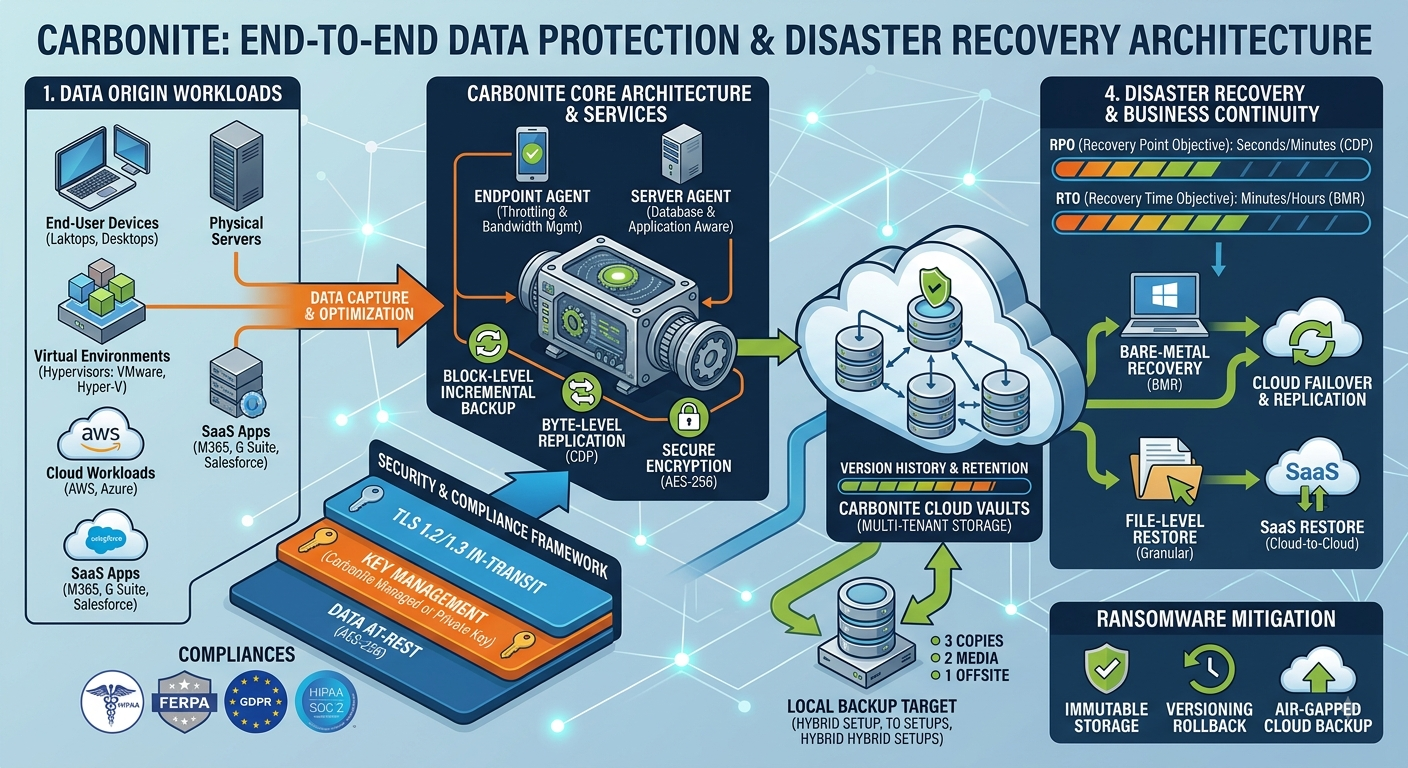
Carbonite is an enterprise-grade cloud backup, data protection, and disaster recovery solution engineered to safeguard critical digital assets across end-user devices, physical servers, virtual environments, and cloud infrastructure. Founded in 2005 and acquired by OpenText in 2019, Carbonite’s technology ecosystem spans automated endpoint protection, continuous data protection (CDP), high-availability replication, and cloud-to-cloud backup.
Understanding Carbonite requires examining its core architecture, encryption standards, virtualization support, data restoration mechanics, and business continuity capabilities.
1. Architectural Overview and Data Transmission
Carbonite operates on a hybrid client-cloud architecture designed to optimize network bandwidth while ensuring real-time or schedule-based data synchronization. The system comprises a local agent software installed on the target machine (endpoint or server) and a distributed backend infrastructure hosted across multi-tenant, secure data centers.
Incremental Bandwidth Optimization
To minimize system overhead, Carbonite uses block-level incremental backups:
- Initial Full Backup: On first run, Carbonite scans designated directories, calculates cryptographic hashes for files, and transfers the baseline snapshot to the cloud repository.
- Block-Level Tracking: Subsequent backup passes do not resend entire files when modifications occur. Instead, the local agent identifies changed data blocks within modified files using delta-detection algorithms. Only the modified blocks are compressed, encrypted, and uploaded.
- Throttling and Dynamic Bandwidth Allocation: Carbonite’s client includes adaptive bandwidth management that monitors network activity. When the host system is actively in use, backup operations throttle upload speeds to avoid latency spikes; when idle, backup throughput increases.
2. Cryptographic Security & Compliance Framework
Data privacy and data integrity are central to Carbonite’s operational model. Data is protected both during transmission and while stored at rest in Carbonite vaults.
+-----------------------------------------------------------------------+
|                           ORIGIN HOST (CLIENT)                        |
|  [ File Systems / Databases ]                                         |
|              │                                                        |
|              ▼                                                        |
|  [ Local Agent: 256-bit AES Encryption (Pre-transmission) ]           |
+------------------------------┬----------------------------------------+
                               │
                               │ TLS 1.2 / TLS 1.3 Encryption
                               ▼
+-----------------------------------------------------------------------+
|                          CARBONITE CLOUD VAULT                        |
|  [ Encrypted Data At-Rest (256-bit AES) ]                             |
|  [ Immutable Storage & Version Control Layers ]                       |
+-----------------------------------------------------------------------+
- Data Encryption at Rest: Files are encrypted locally on the agent side prior to transmission using 256-bit Advanced Encryption Standard (AES) encryption.
- Encryption in Transit: Payload transport between client endpoints and Carbonite data centers is shielded using TLS 1.2 or TLS 1.3 cryptographic protocols to prevent man-in-the-middle (MitM) attacks.
- Key Management Models:
- Standard Management: Carbonite manages encryption keys via secure key vaults, enabling administrative password resets and cloud-side file viewing.
- Private Key Management (Zero-Knowledge): Enterprise administrators can generate and manage custom, private encryption keys. Under this framework, Carbonite holds no record of the decryption key. While this maximizes data privacy, losing the private key results in permanent, unrecoverable data loss.
- Regulatory Alignment: Carbonite helps organizations meet requirements under HIPAA, FERPA, and GDPR by offering compliant logging, auditing, role-based access control (RBAC), and physical data center security certifications (SOC 2 Type II).
3. Core Enterprise Offerings & Workload Coverage
Carbonite addresses diverse organizational infrastructure requirements through targeted software tiers:
| Solution Tier | Target Infrastructure | Core Capabilities |
| Carbonite Safe (Endpoint) | Workstations, Laptops, SMB Desktops | Continuous background backup, automatic external drive inclusion, user-driven file restoration, version history (up to 30 days). |
| Carbonite Server | Physical Servers, Hypervisors (Hyper-V, VMware), Databases | Image-state and file-level backups, SQL Server and Exchange database agent integration, system-state snapshots, bare-metal recovery (BMR). |
| Carbonite Availability | Mission-critical workloads (Physical, Virtual, Cloud) | Continuous Data Protection (CDP), real-time byte-level replication, near-zero RPO/RTO failover capability. |
| Carbonite Cloud-to-Cloud | SaaS Applications (Microsoft 365, Salesforce, Google Workspace) | Independent cloud-based backup protecting SaaS data against accidental deletion, malicious insider threats, and ransomware overhead. |
4. Disaster Recovery, RPO/RTO, and Continuous Data Protection
In disaster recovery (DR) planning, performance is measured by two key metrics:
- Recovery Point Objective (RPO): The maximum tolerable age of unrecovered data.
- Recovery Time Objective (RTO): The maximum acceptable duration of system downtime.
       [ Normal Operations ]                 [ Disaster Event ]
----------------─┼────────────────────────────────────┼─────────────────► Time
                 │                                    │
                 │◄─── Recovery Point Objective ───►│ │
                 │      (Data Loss Window)            │ │
                 │                                    │◄─ Recovery Time Objective ─►│
                 │                                    │   (Downtime / Restore Window)
Continuous Replication & Byte-Level CDP
For mission-critical environments, Carbonite Availability uses byte-level replication technology:
- The replication driver hooks directly into the operating system’s I/O stack.
- As write operations occur on the target storage volumes, the changed bytes are captured synchronously or asynchronously and transmitted across LAN/WAN links to a target secondary server (onsite or in the cloud).
- This architecture lowers RPOs down to seconds, ensuring minimal data loss during an unexpected hardware crash or hypervisor failure.
Bare-Metal Recovery (BMR)
For catastrophic hardware failures, Carbonite Server provides Bare-Metal Recovery:
- The administrator creates a bootable ISO or USB rescue medium.
- The target hardware is booted using the recovery media, establishing a secure handshake with the Carbonite cloud vault or local backup target.
- The agent formats the disk, reinstalls system partitions, restores the full operating system, system state, registry, applications, and user configurations without requiring pre-installed OS software on the target server.
5. Ransomware Mitigation and Retention Policies
Ransomware routinely targets shadow copies and local backup repositories to prevent restoration. Carbonite combats this threat through distinct architecture choices:
- Immutable Retention & Versioning: Carbonite maintains multiple historical versions of changed or deleted files. If ransomware encrypts local files, the system syncs the encrypted files as new versions rather than overwriting historical backups. Administrators can rollback file systems to a precise timestamp immediately preceding the infection.
- Isolated Cloud Repositories: Because backup repositories sit isolated behind secondary authentication layers and encrypted network pipes, ransomware running on local endpoints cannot easily discover or wipe cloud-hosted backup vaults.
- Air-Gapped Secondary Targets: Hybrid implementations allow local backup targets (such as Network Attached Storage or dedicated local servers) to pair with cloud-hosted vaults, fulfilling the 3-2-1 backup rule: 3 copies of data, across 2 different media types, with 1 copy stored offsite.
Carbonite remains an integral platform for business continuity, offering scalable, secure, and resilient data protection mechanisms across personal endpoints, complex hybrid clouds, and SaaS enterprise suites.
Also Read: Understanding Tutanota (Tuta): The Vanguard of Secure, Private Communication – My Tech Blaze
Source: Download the Latest Version of Carbonite Safe | Carbonite