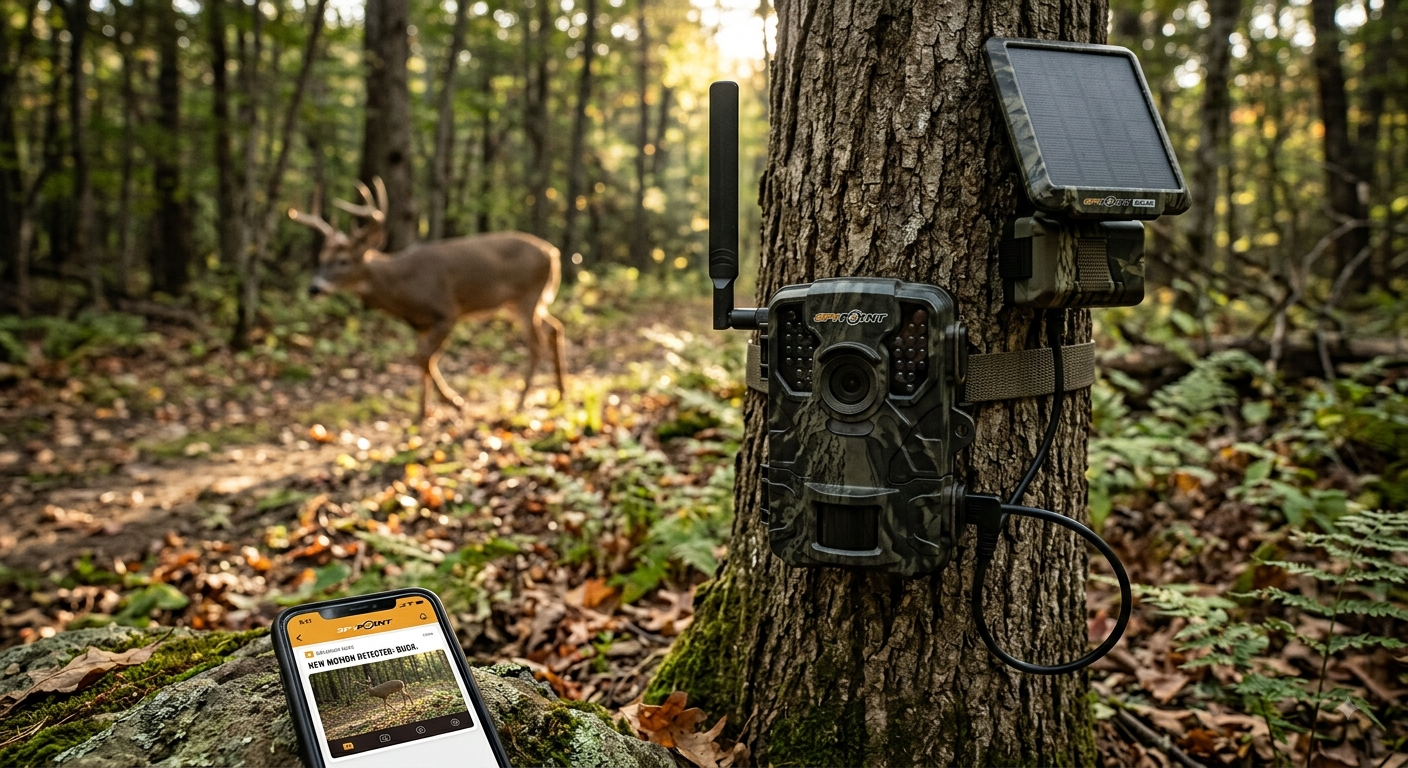
Cellular trail cameras have fundamentally altered remote wildlife monitoring, perimeter security, and game management. Rather than requiring users to manually retrieve SD cards, modern connected cameras capture, process, and transmit imaging data over cellular networks directly to cloud infrastructure. At the forefront of this evolution is SPYPOINT, a pioneer in integrating low-power edge computing, dual-SIM technology, and cloud-based computer vision into battery-operated field hardware.
1. Edge Hardware & Image Sensor Optics
At the core of any SPYPOINT camera (such as the FLEX series or Force-Pro models) lies an embedded optical pipeline designed to operate reliably under extreme environmental conditions.
+------------------+     +------------------+     +-------------------+
|  PIR Motion      | --> |  ARM / RISC-V    | --> | Dual-LTE Modem    |
|  Sensor Array    |     |  Edge Processor  |     | (Multi-Carrier)   |
+------------------+     +------------------+     +-------------------+
                                   |                        |
                                   v                        v
                         +-------------------+    +-------------------+
                         | Compressed Image  |    | Cloud Server      |
                         | (Local Storage)   |    | (AI Processing)   |
                         +-------------------+    +-------------------+
Optical & Trigger Architecture
- Passive Infrared (PIR) Sensor Arrays: SPYPOINT units utilize multi-zone PIR sensors calibrated to detect changes in thermal contrast across a specified field of view. Trigger speeds routinely hit ranges between 0.3s to 0.4s, minimizing “empty captures” caused by high-velocity targets.
- Night Vision & Flash Technology: Equipped with high-efficiency infrared LEDs (either standard 850nm low-glow or 940nm no-glow variants), the hardware modulates illumination duration using ambient light sensors to prevent washing out close-range subjects while illuminating targets up to 100 feet away.
- Image Compression: Sensor raw data is processed locally by an optimized image signal processor (ISP) to adjust gain, dynamic range, and exposure before encoding the image into compressed JPEGs optimized for bandwidth-constrained cellular transmission.
2. Cellular Communication & Dual-SIM Architecture
Transmitting imagery from remote, weak-signal environments requires a robust, low-power cellular network implementation.
Dual-Carrier Auto-Connecting Modems
One of SPYPOINT’s primary technical advantages is its pre-activated Dual-SIM / Multi-Carrier configuration (e.g., in the FLEX series).
- Carrier Provisioning: The integrated eSIM/SIM array contains pre-provisioned profiles for major telecommunications networks (such as Verizon and AT&T in North America, or major European carriers).
- Signal Scanning: Upon startup, the internal modem performs a cellular frequency sweep to evaluate local signal metrics:
- RSSI (Received Signal Strength Indicator)
- RSRP (Reference Signal Received Power)
- RSRQ (Reference Signal Received Quality)
- Dynamic Routing: The device automatically registers onto the network yielding the highest carrier link quality without requiring manual SIM swaps from the user.
Power-Aware Network Protocols
Cellular radios are inherently energy-intensive. SPYPOINT minimizes battery drain by employing optimized transport protocols:
- HTTP/HTTPS & Lightweight MQTT: Images and telemetry metadata (battery voltage, signal strength, internal temperature) are sent using compressed payloads via encrypted TLS sockets.
- Transmission Windowing: Rather than keeping the cellular modem continuously active in a high-power state, the system operates on a burst-transmission schedule or instant-trigger upload cycle, dropping back into a ultra-low-power sleep state (drawing microamperes) immediately post-transmission.
3. Firmware, Power Management, and Firmware-Over-The-Air (FOTA)
Operating off-grid for months or years necessitates precise power budgeting and dynamic energy management.
| Power Mode | Microcontroller State | Cellular Radio State | PIR Sensor | Power Consumption |
| Deep Sleep | Low-Frequency RTC active | Powered Down | Active | ~ Microamperes ($\mu\text{A}$) |
| Capture & ISP | High-Frequency Active | Powered Down / Standby | Triggered | ~ Tens of Milliamperes ($\text{mA}$) |
| Transmission | Active | Transmitting (LTE Peak) | Active | ~ Hundreds of Milliamperes ($\text{mA}$) |
Power Supply Options
SPYPOINT hardware supports flexible power configurations, including:
- Standard AA alkaline/lithium cells.
- Rechargeable lithium battery packs (e.g., LIT-22).
- Integrated solar panels backed by lithium-ion internal buffers (e.g., the SPYPOINT Solar series).
Remote Maintenance via FOTA
To ensure field-deployed hardware remains secure and functional, SPYPOINT utilizes FOTA (Firmware-Over-The-Air) updates. Firmware binaries are chunked, validated via checksums, and transmitted during routine communication check-ins, allowing remote upgrades of camera logic, modem protocols, and power management profiles without manual physical intervention.
4. Cloud Infrastructure and AI Computer Vision
Once an image reaches the SPYPOINT cloud infrastructure, it undergoes high-throughput server-side processing before reaching the end-user application.
[ Field Camera ] ---> (Encrypted LTE) ---> [ SPYPOINT Cloud Gateway ]
                                                    |
                                                    v
                                        [ BUCK-TRACKER AI Engine ]
                                                    |
                                      +-------------+-------------+
                                      |             |             |
                                  (Antlers)      (Human)       (Vehicle)
                                      |             |             |
                                      +-------------+-------------+
                                                    |
                                                    v
                                        [ Push Notification / App ]
Server-Side Data Ingestion Pipeline
- Metadata Parsing: Telemetry is stored in relational databases to power diagnostics dashboards (battery health graphs, signal history).
- Image Processing & Storage: High-resolution uploads are archived in secure blob storage, while scaled down versions are pushed to client applications for fast loading.
BUCK-TRACKER™ AI Detection Engine
SPYPOINT integrates proprietary machine learning models into its cloud platform:
- Object Classification: Convolutional Neural Networks (CNNs) analyze image frames to classify targets into categories such as Deer, Antlers, Moose, Bears, Humans, and Vehicles.
- Smart Filtering: Users can create custom notification filters (e.g., “Only alert me when a mature buck is detected”), significantly reducing notification noise caused by wind-blown foliage or non-target wildlife.
Technical Summary
The engineering behind SPYPOINT devices balances optical efficiency, low-power computing, resilient multi-carrier connectivity, and server-side machine learning. By shifting the heavy computational burden of image classification to the cloud while keeping the edge hardware strictly focused on rapid detection and power-efficient transmission, SPYPOINT delivers an enterprise-grade IoT solution tailored for rugged, off-grid deployments.
Also Read: The Complete Guide to 1Password: Security, Features, and Architecture – My Tech Blaze
Source:Leading Trail Camera Solutions – Cellular, Smart, Powerful | SPYPOINT