1. Introduction & Core Concept
In modern high-throughput, low-latency computing systems, the challenge of maintaining real-time data consistency across distributed or persistent storage nodes remains paramount. NAVRUF—an acronym for Non-volatile Asynchronous Virtual Real-time Update Framework—is an architectural model designed to handle high-frequency state changes without compromising system durability or transaction latency.
Traditional transactional models (such as traditional ACID-compliant write-ahead logging) often suffer from write amplification and disk/NVM (Non-Volatile Memory) synchronization bottlenecks. NAVRUF addresses these limitations by decoupling the in-memory virtual state layer from the underlying physical persistent commit log using asynchronous write vectors and lightweight transaction frames.
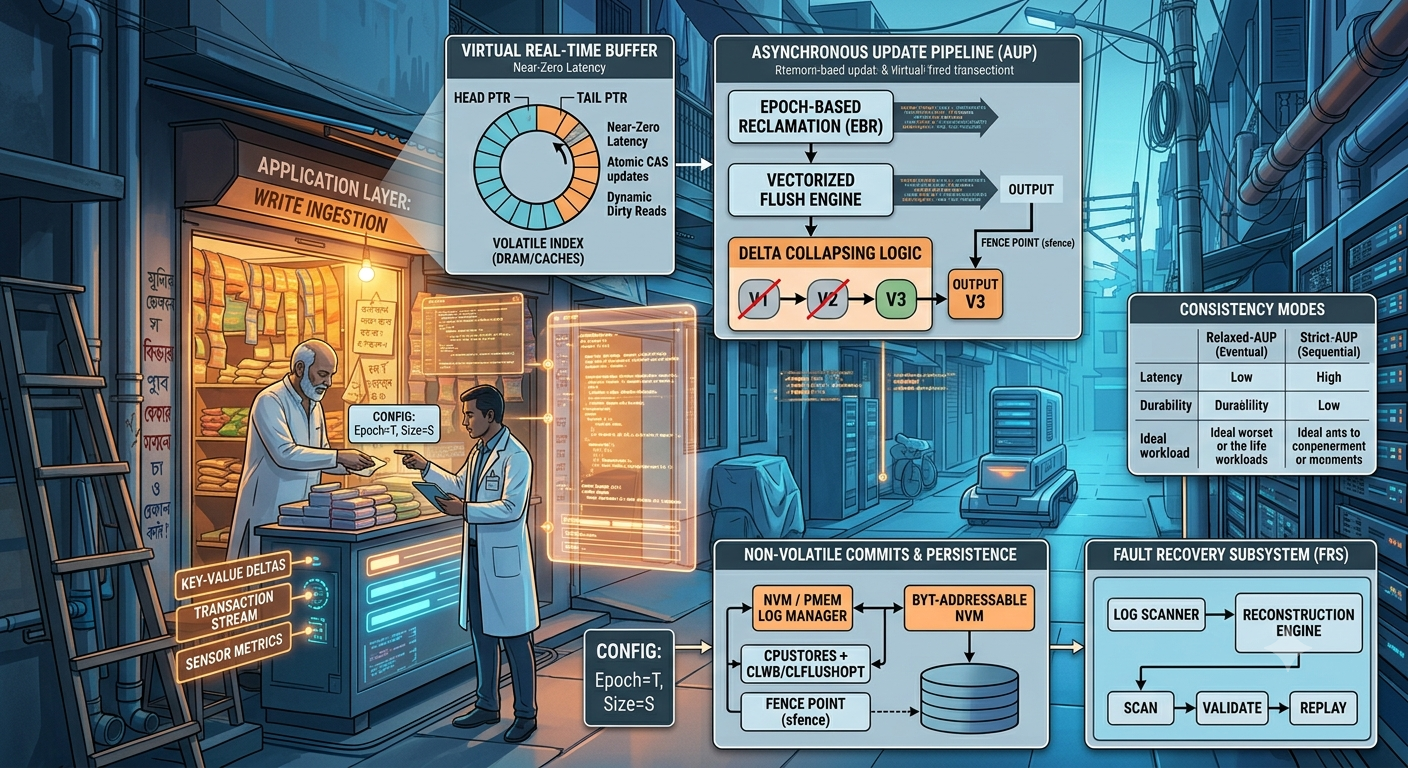
2. High-Level Architecture
The NAVRUF model consists of four primary structural components working in concert:
+-------------------------------------------------------------------+
|                        Application Layer                          |
+-------------------------------------------------------------------+
                                  |
                                  v
+-------------------------------------------------------------------+
|                  Virtual Real-Time Buffer (VRTB)                  |
|          - Lock-free ring buffer                                  |
|          - Atomic index pointer manipulation                      |
+-------------------------------------------------------------------+
                                  |
                                  v
+-------------------------------------------------------------------+
|               Asynchronous Update Pipeline (AUP)                  |
|          - Vectorized flush engines                               |
|          - Transaction delta merging                              |
+-------------------------------------------------------------------+
                                  |
                                  v
+-------------------------------------------------------------------+
|             Non-Volatile Recovery & Commit Engine                 |
|          - Persistent Memory (PMEM) / NVDIMM backing              |
|          - Shadow paging & delta logging                          |
+-------------------------------------------------------------------+
Key Components
- Virtual Real-Time Buffer (VRTB):
- Operates entirely in volatile DRAM or fast L3-cache-resident memory structures.
- Employs lock-free ring buffers with single-producer/multi-consumer (SPMC) or multi-producer/multi-consumer (MPMC) access patterns.
- Serves read queries directly, providing near-zero latency for read-heavy or write-heavy concurrent updates.
- Asynchronous Update Pipeline (AUP):
- Batches volatile update deltas into standardized execution vectors.
- Utilizes lock-free epoch-based reclamation (EBR) to ensure thread safety without lock contention.
- Merges overlapping key updates to reduce total written bytes before persisting to media.
- Persistent Memory Log Manager (PMLM):
- Interfaces directly with byte-addressable persistent memory (e.g., CXL-attached NVM, NVDIMM).
- Executes CPU cache line flushes (
clwborclflushopt) followed by memory fences (sfence) to ensure ordering and persistence without kernel context switches.
- Fault Recovery Subsystem (FRS):
- Scans non-volatile commit pointers upon system reboot or unexpected power failure.
- Reconstructs the volatile VRTB state in $O(N)$ time relative to unprocessed delta logs.
3. The Execution Lifecycle
The transaction flow in a NAVRUF-compliant system follows three deterministic stages: Ingestion, Vectorization, and Commit Persistence.
Stage 1: Ingestion & Volatile Framing
When a client application issues an update payload $\Delta$, the NAVRUF engine performs an atomic compare-and-swap (CAS) operation on the VRTB tail pointer.
C
typedef struct {
    uint64_t transaction_id;
    uint32_t key_hash;
    uint32_t payload_len;
    uint8_t  flags;
    uint8_t  payload[];
} navruf_delta_frame_t;
The payload is assigned a global monotonically increasing sequence number (LSN). At this point, the update is speculative but immediately queryable by local thread readers configured for dynamic dirty reads.
Stage 2: Asynchronous Vectorization & Delta Compression
Instead of issuing synchronous memory flushes per operation, NAVRUF’s background worker threads aggregate frames into dynamic execution vectors based on two triggers:
- Time-based threshold: Eviction occurs every $T_{\mu s}$ microseconds.
- Size-based threshold: Eviction occurs when the vector reaches $S_{bytes}$.
During aggregation, NAVRUF performs Delta Collapsing. If an entry with hash $K_1$ is modified multiple times ($V_1 \rightarrow V_2 \rightarrow V_3$) within the same epoch, only $V_3$ is staged for the persistent commit vector, eliminating unnecessary write cycles to persistent media.
Stage 3: Persistent Execution & Fencing
Once vectorized, the AUP issues direct store operations to byte-addressable NVM. The write sequence follows a strict hardware memory ordering pipeline:
- Copy frame payload to persistent log region via high-speed SIMD (
AVX-512/AVX2) memory copy operations. - Issue
clwb(Cache Line Write Back) across the modified address range. - Execute
sfenceto ensure memory write instructions complete before updating the global tail pointer. - Atomically advance the persistent head pointer.
4. Fault Tolerance and Consistency Guarantees
NAVRUF provides tunable consistency models ranging from Eventual Persistence to Sequential Durability:
| Mode | Latency Profile | Durability Guarantee | Ideal Workload |
| Relaxed-AUP | Lowest ($<1 \mu s$) | Window of vulnerability equal to Epoch time $T_{\mu s}$ | High-frequency telemetry, sensor metrics |
| Strict-AUP | Low ($2-5 \mu s$) | Zero data loss; guaranteed durability before ACK | Financial trading state machines, session management |
Crash Recovery Mechanism
Upon power loss or system failure, NAVRUF recovers state through a two-pass scan:
- Pass 1 (Validation): The recovery manager inspects the persistent log’s header checksums. Uncommitted or partial writes resulting from mid-flight power failure are truncated at the last valid
sfencemarker. - Pass 2 (Replay): Valid persistent deltas are replayed into the VRTB to restore volatile indexes to the exact point of the last durable checkpoint.
5. Performance Advantages
By merging volatile memory performance with non-volatile persistence guarantees, NAVRUF addresses key architectural bottlenecks:
- Elimination of Lock Contention: Through epoch-based lock-free ring buffers, NAVRUF removes global lock bottlenecks under high concurrency.
- Reduced Write Amplification: Delta collapsing in the AUP reduces physical write cycles to persistent media by up to 60–80% in heavy write workloads.
- Predictable Tail Latency: Asynchronous offloading prevents write stalls, keeping $p99.9$ tail latencies flat under load spikes.
6. Conclusion
The NAVRUF framework bridges the gap between ultra-low-latency in-memory data processing and non-volatile persistence guarantees. By isolating thread execution paths from hardware synchronization instructions via the Asynchronous Update Pipeline, NAVRUF provides a scalable blueprint for modern high-throughput systems, distributed datastores, and real-time state engines.
Also Read: Understanding iiNet, Legacy Domains, and the POP3 Landscape – My Tech Blaze
Source: Update Your Navruf GPS Maps Easily | PDF | Global Positioning System | Login