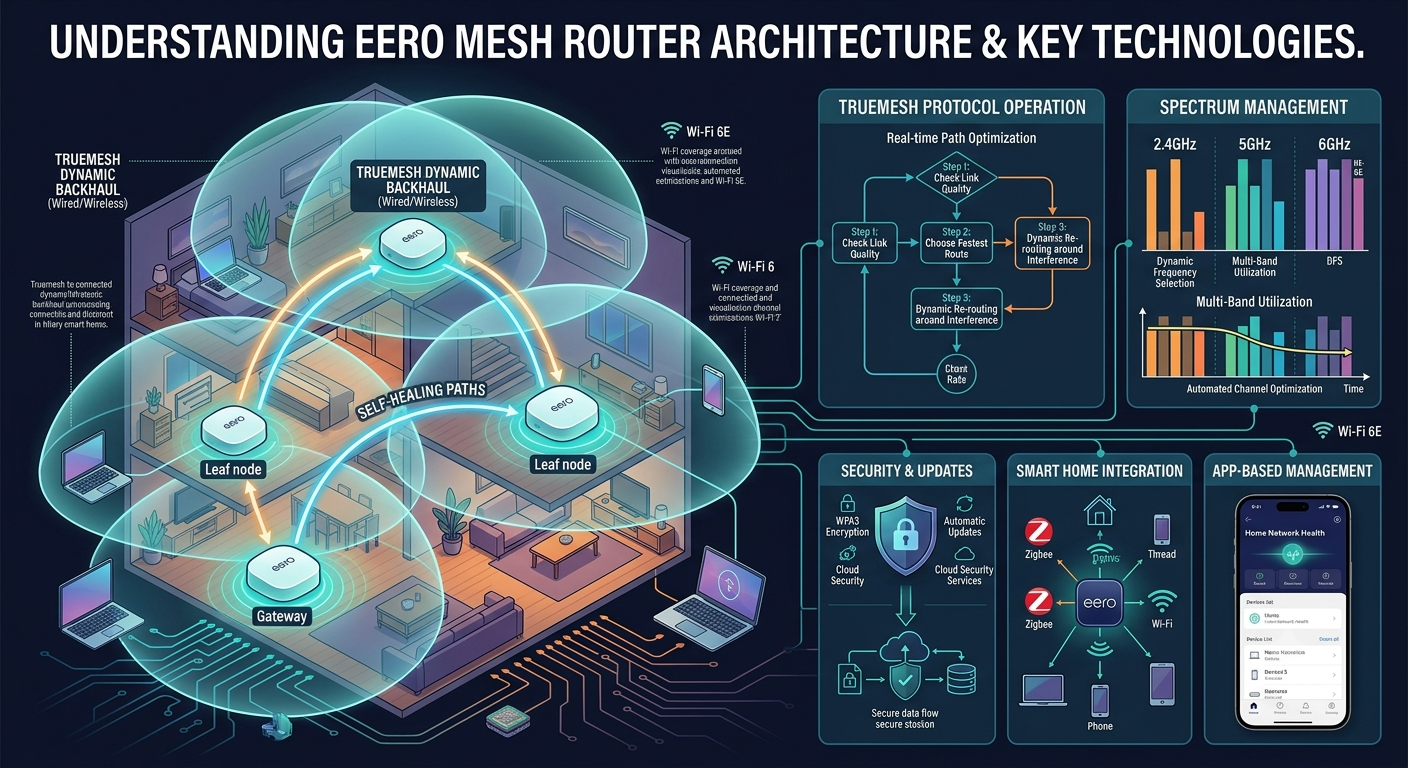
As residential and enterprise network demands scale beyond the capacity of single-point wireless access points (APs), Software-Defined Mesh Networking (SDMN) has emerged as the standard for uniform spatial coverage. Amazon’s eero router platform represents a shift from legacy star-topology Wi-Fi setups to a self-healing, multi-node wireless mesh system.
By offloading path selection and channel allocation to an intelligent control plane, eero mitigates common wireless bottlenecks such as co-channel interference, hidden node problems, and attenuation across structural barriers.
1. Topographic Overview: Star vs. Mesh Topology
Traditional home networks rely on a centralized wireless router operating in a star topology. Signal strength degrades according to the Inverse-Square Law for electromagnetic radiation:
$$P_r \propto \frac{1}{d^2}$$
Where $P_r$ is received power and $d$ is distance. High-frequency bands (such as 5 GHz and 6 GHz) suffer severe free-space path loss and attenuation when penetrating dense media like concrete or brick.
Star Topology (Legacy):
[ Access Point ] <---> [ Client A ]
                 <---> [ Client B (Weak signal due to distance/walls) ]

Mesh Topology (eero):
[ Gateway Node ] <--- Peer Link ---> [ Leaf Node 1 ]
       ^                                    ^
       |------------- Peer Link ------------| <---> [ Client B (Strong Local Link) ]
eero replaces this single source with a distributed peer-to-peer topology:
- Gateway Node: Connected directly to the modem via Ethernet WAN, serving as the network’s DHCP server, NAT router, and edge security gateway.
- Leaf/Satellite Nodes: Distributed throughout the physical environment, acting as access points for local client devices and relay stations for multi-hop data packet forwarding.
2. Dynamic Path Selection & The TrueMesh Protocol
At the core of eero’s technical architecture is TrueMesh, a proprietary routing algorithm operating primarily at the Link Layer (Layer 2) of the OSI model. Legacy mesh repeaters often static-route traffic through predetermined hops or rely on standard Spanning Tree Protocols (STP), which cut total bandwidth in half with each wireless hop.
Algorithmic Routing Engine
TrueMesh continually measures link quality between all adjacent nodes across all available radio bands simultaneously. Instead of relying purely on RSSI (Received Signal Strength Indicator), it calculates a dynamic cost metric for every potential transmission path using parameters such as:
- Packet Loss Rate ($L$): Historical dropped frame metrics.
- Latency ($T$): Round-trip time for probe frames between node pairs.
- Available Bandwidth ($B$): Current channel utilization and congestion level.
- Hop Count ($H$): Penalty applied to multi-hop routes to minimize latency accumulation.
$$\text{Path Cost} = f(L, T) + \frac{\alpha}{B} + \beta \cdot H$$
By dynamically updating this metric, eero nodes steer traffic in real time. If a household appliance introduces transient RF interference on a 5 GHz channel, TrueMesh reroutes frame delivery through a 2.4 GHz or secondary 5/6 GHz backhaul link within milliseconds without dropping active TCP connections.
3. Radio Frequency (RF) Management & Spectrum Allocation
Modern eero routers (such as the eero Pro 6, Pro 6E, and Max 7) utilize multi-band architectures spanning 2.4 GHz, 5 GHz, and 6 GHz spectrums.
| Band | Channel Width | Characteristics | Primary Mesh Role |
| 2.4 GHz | 20 / 40 MHz | Long range, high obstacle penetration, high noise floor | Legacy IoT devices, emergency mesh backhaul |
| 5 GHz | 80 / 160 MHz | High throughput, moderate penetration | High-density client traffic, dynamic backhaul |
| 6 GHz | 160 / 320 MHz | Ultra-wide spectrum, minimal interference, short range | Dedicated/Dynamic high-speed node-to-node backhaul |
Dynamic Frequency Selection (DFS) & Channel Optimization
eero continually scans the local RF spectrum in the background to build an environment interference map. Using Auto Channel Selection (ACS), the network dynamically shifts nodes to unoccupied DFS channels (radar-shared spectrum) or cleaner, non-overlapping channels to maximize Signal-to-Noise Ratio (SNR):
$$\text{SNR (dB)} = P_{\text{signal}} (\text{dBm}) – P_{\text{noise}} (\text{dBm})$$
Furthermore, eero nodes support MU-MIMO (Multi-User, Multiple-Input, Multiple-Output) and OFDMA (Orthogonal Frequency-Division Multiple Access), allowing simultaneous frame delivery to multiple clients across divided sub-carriers (Resource Units) within a single transmission window.
4. Software-Defined Control Plane & Edge Security
eero employs a hybrid control plane model split between the local hardware nodes and a secure cloud-based controller.
+-------------------------------------------------------------+
|                     eero Cloud Engine                       |
|   (Global Topology Maps, ML Channel Models, OTA Updates)    |
+-------------------------------------------------------------+
                               ^
                               | Encrypted TLS Telemetry
                               v
+-------------------------------------------------------------+
|                   Local eero Node Fleet                     |
|  [ Layer 2 TrueMesh ] <-> [ eNode Edge Security / DNS ]     |
+-------------------------------------------------------------+
- Local Data Plane: Data packet forwarding, frame encapsulation, client steering (IEEE 802.11k/v/r standards for fast roaming), and local NAT routing are performed locally on hardware system-on-chips (SoCs) to eliminate cloud dependencies for intra-network communications.
- Cloud Management Plane: Telemetry regarding client density, throughput metrics, and RF noise floors is securely streamed to the eero cloud engine. Machine learning models analyze these trends over time, optimizing channel assignments and deploying wireless radio calibration profiles customized for each specific home layout.
Smart Home Protocol Integration
Beyond standard Wi-Fi, modern eero routers integrate hardware controllers for low-power mesh IoT protocols, including Zigbee and Thread (IEEE 802.15.4), alongside support for the Matter unified connectivity framework. Actively running a Thread Border Router directly on the gateway eliminates the need for separate third-party hubs, establishing a consolidated IPv6-based local network fabric for smart home devices.
Summary
By replacing static routing and isolated AP topologies with dynamic Layer 2 mesh orchestration, multi-band backhaul optimization, and automated cloud-assisted RF management, the eero system solves key challenges in modern residential wireless networking. It maintains high SNR, low latency, and seamless IEEE 802.11k/v roaming across varying physical obstacles and dense client environments.
Source: eero 6 Router | Ring