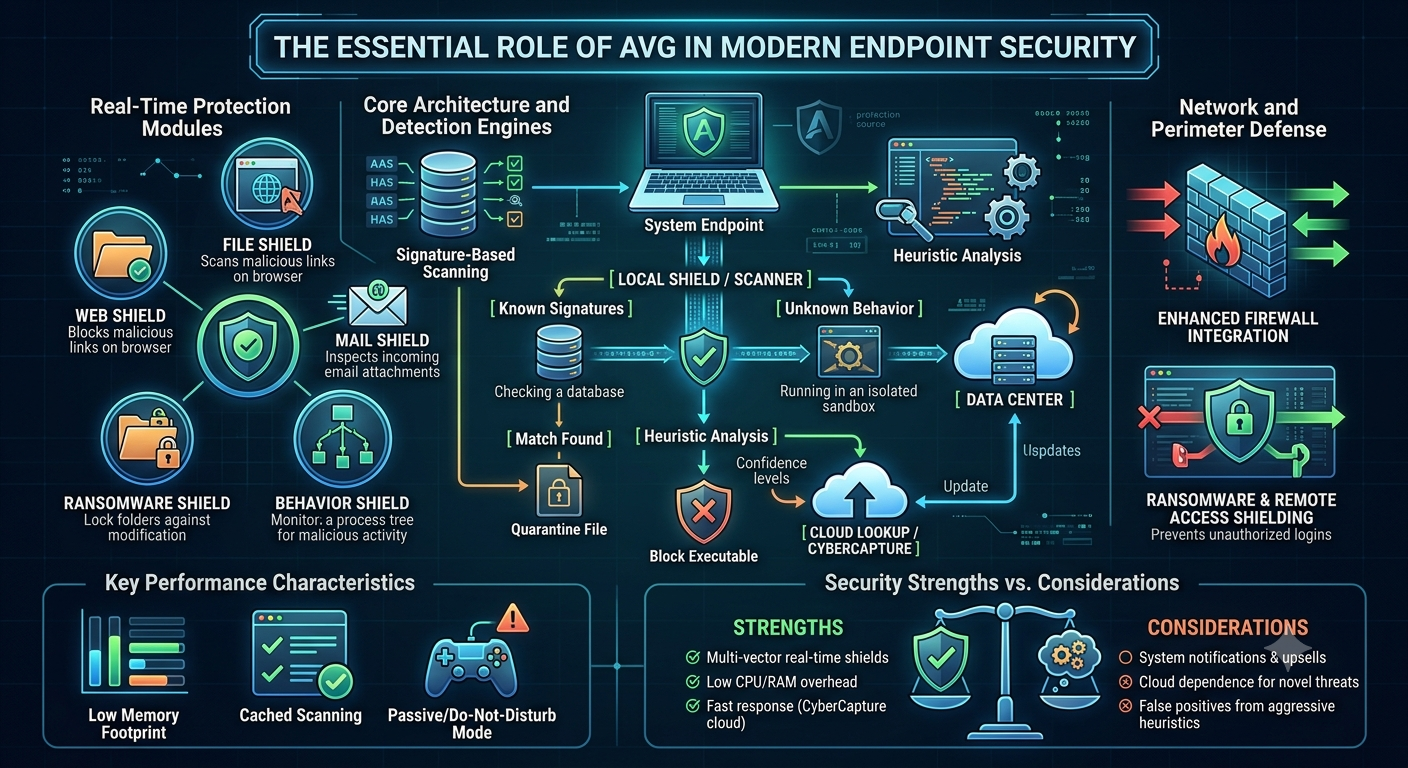
In the modern cybersecurity ecosystem, safeguarding digital assets requires robust, multi-layered protection mechanisms. Among the pioneer antivirus and security suites available today, AVG (originally Anti-Virus Guard, now developed by Gen Digital) remains a key player in endpoint protection. Designed to mitigate risks ranging from traditional malware to complex zero-day threats, AVG integrates heuristic analysis, cloud-based threat detection, real-time file monitoring, and network protection into a lightweight engine.
1. Core Architecture and Detection Engines
AVG operates on a hybrid architecture that combines local signature-based scanning with dynamic cloud-assisted threat analysis. This approach strikes a critical balance between system performance and threat coverage.
                  +-----------------------------------+
                  |        System Endpoint            |
                  +-----------------------------------+
                                    |
                        [ Local Shield / Scanner ]
                                    |
                    +---------------+---------------+
                    |                               |
           Known Signatures                 Unknown Behavior
                    |                               |
            [ Match Found ]                 [ Heuristic Analysis ]
                    |                               |
            (Quarantine File)               +-------+-------+
                                            |               |
                                     Low Confidence   High Confidence
                                            |               |
                                   [ Cloud Lookup ]  (Block Executable)
                                   (CyberCapture)
Signature-Based Scanning
At its foundation, AVG utilizes a database of known threat signatures—unique sequences of bytes or cryptographic hashes (such as SHA-256) associated with identified malware. When a scan is executed or a file is accessed, AVG compares file contents against this database. Signature matching provides instant detection for established threats with virtually zero false positives.
Heuristic Analysis
Because new malware variants emerge continuously, signature matching alone is insufficient. AVG employs static and dynamic heuristics to detect suspicious code structures or behaviors. Static heuristics analyze file headers, entry points, and machine-code patterns without executing the file. Dynamic heuristics run suspicious files inside an isolated runtime environment (a sandbox) to observe action vectors such as unauthorized registry modifications, process injection, or hidden network callbacks.
Cloud-Based Threat Detection (CyberCapture)
When AVG encounters an unknown, potentially malicious file, it offloads analysis to CyberCapture, a cloud-based sandbox system. The file is isolated, uploaded, and subjected to deep automated behavioral analysis on secure cloud servers. Once evaluated, threat definitions are updated globally across all endpoints within minutes.
2. Real-Time Protection Modules
AVG’s architecture relies on distinct real-time shields that monitor endpoint activity at every major attack vector.
| Shield Module | Primary Target | Operational Mechanism |
| File Shield | Local files and storage | Intercepts I/O read/write calls; scans files prior to execution or storage. |
| Web Shield | Web traffic (HTTP/HTTPS) | Scans incoming packets for scripts, drive-by downloads, and malicious URLs. |
| Mail Shield | Email attachments | Inspects incoming/outgoing SMTP, POP3, and IMAP protocols for embedded payloads. |
| Ransomware Shield | Critical file directories | Prevents unauthorized processes from modifying protected file paths or encrypting data. |
| Behavior Shield | Running processes | Monitors live execution paths for process hijacking, code injection, or rapid file encryption. |
3. Network and Perimeter Defense
In addition to host-level inspection, AVG incorporates network-level safety measures to block intrusions before payloads reach system memory.
Enhanced Firewall Integration
AVG includes a two-way firewall that inspects incoming and outgoing network traffic. By analyzing packet headers, ports, and protocols against configurable security rules, the firewall blocks port scans, unauthorized remote desktop protocol (RDP) attempts, and covert data exfiltration.
Ransomware and Remote Access Shielding
With the rise of targeted ransomware attacks on enterprise and personal endpoints, remote access protocols (such as RDP and VNC) have become primary entry points. AVG’s network defense modules monitor brute-force sign-in attempts on common administrative ports, automatically blocking IP addresses that display suspicious connection patterns.
4. Key Performance Characteristics
A central challenge for any endpoint security solution is minimizing system overhead while maintaining rigorous protection. AVG optimizes performance through several engineering practices:
- Low Memory Footprint: Background services are modularized, enabling the system to allocate memory dynamically depending on active user tasks.
- Cached Scanning (Persistent Caching): Files previously verified as clean are cached in an internal database and bypassed during subsequent scans unless modified, reducing CPU cycle consumption.
- Passive/Do-Not-Disturb Mode: AVG automatically detects full-screen applications (such as games or presentations) and suppresses notifications, background updates, and scheduled scans to conserve computing resources.
5. Security Strengths vs. Considerations
Evaluating AVG from an engineering perspective highlights several functional strengths and operational tradeoffs.
                           +---------------------------+
                           |  AVG Security Evaluation  |
                           +---------------------------+
                                         |
                +------------------------+------------------------+
                |                                                 |
         [ Strengths ]                                     [ Considerations ]
  - Multi-vector real-time shields                  - System notifications & upsells
  - Low CPU/RAM operational overhead                - Cloud dependence for novel threats
  - Fast response via CyberCapture cloud            - False positives from aggressive heuristics
Strengths
- Comprehensive Multi-Vector Defense: Covers file systems, web traffic, network interfaces, and email channels simultaneously.
- Rapid Threat Propagation: Cloud integration ensures protection against novel zero-day threats within minutes of global detection.
- Scalable Engine: Works reliably across diverse consumer and small-business endpoint configurations without requiring high-end hardware.
Considerations
- Heuristic False Positives: Aggressive behavior monitoring can occasionally flag custom software development scripts or niche utility tools as suspicious.
- Interface Overhead: Consumer versions often feature promotional prompts or upsells for secondary tools (such as VPNs or cleanup utilities), which require configuration management in controlled environments.
Conclusion
AVG provides a robust, layered security framework capable of countering contemporary cyber threats. By combining local signature scanning, heuristic behavioral analysis, and cloud-assisted intelligence like CyberCapture, AVG delivers solid defense against malware, spyware, and ransomware while maintaining efficient resource utilization.
Also Read: The Evolution of the Desktop Inbox: An In-Depth Look at Mailbird – My Tech Blaze‘
Source: AVG 2026 | FREE Antivirus, VPN & TuneUp for All Your Devices