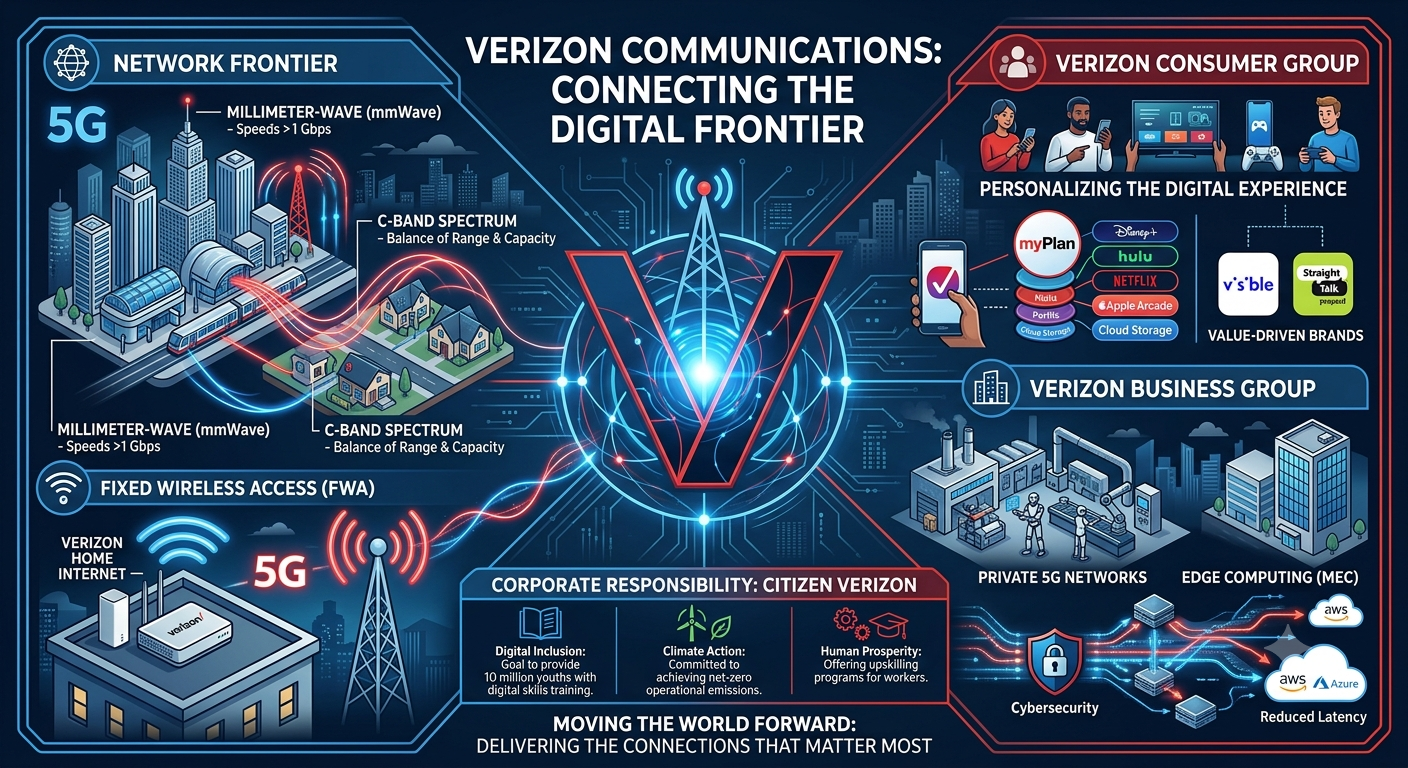
In an era defined by rapid technological evolution, Verizon Communications Inc. stands as a cornerstone of global connectivity. As one of the world’s largest telecommunications companies, Verizon does not merely provide network bars on a smartphone screen; it architects the invisible infrastructure that powers modern businesses, connects families, and drives the next generation of industrial automation.
From its roots in the traditional bell operating systems to its current standing as a leader in 5G technology, broadband, and enterprise solutions, Verizon’s trajectory reflects the broader story of human connection in the 21st century.
The Network Frontier: The Power of 5G and Beyond
At the heart of Verizon’s value proposition is its network. The company has long staked its reputation on network reliability, a claim backed by billions of dollars in annual capital expenditures.
1. 5G Ultra Wideband (UWB)
Verizon’s deployment of 5G is split into two primary architectures: Nationwide 5G (using low-band spectrum for broad coverage) and 5G Ultra Wideband (utilizing millimeter-wave and C-band spectrum).
- Millimeter-Wave (mmWave): Offers unprecedented speeds, often exceeding 1 Gbps, with incredibly low latency. This is deployed in dense urban areas, stadiums, and transit hubs.
- C-Band Spectrum: The sweet spot of 5G. It provides the perfect balance, offering the massive capacity and high speeds of mmWave but across the wider geographic reaches typically associated with low-band frequencies.
2. Fixed Wireless Access (FWA)
One of Verizon’s most disruptive modern offerings is Verizon Home Internet. By leveraging its robust 5G network, Verizon provides high-speed broadband to homes and businesses without the need for digging trenches or laying physical fiber-optic cables to the premises. This has allowed Verizon to aggressively compete with traditional cable monopolies, bringing choice and competitive pricing to underserved rural and suburban markets alike.
Verizon Consumer Group: Personalizing the Digital Experience
For the everyday consumer, Verizon is the gateway to digital life. The Consumer Group focuses on delivering seamless experiences across mobile devices, home internet, and entertainment.
The Ecosystem of Choice
Modern consumers demand flexibility. Verizon has shifted away from rigid, one-size-fits-all contracts toward modular, customizable plans. Through initiatives like myPlan, users can select their base network performance and then stack “perks” according to their lifestyle. These perks include:
- Premium streaming services (Disney+, Hulu, Netflix, Max)
- Cloud storage solutions
- Gaming passes (Apple Arcade, Xbox Game Pass)
- International travel data
By acting as a central hub for consumer subscriptions, Verizon increases customer loyalty (reducing “churn”) while providing genuine cost savings to families.
Value-Driven Brands
Recognizing that the premium postpaid market is only one segment of the population, Verizon has diversified its portfolio. With the acquisition of TracFone Wireless, Verizon solidified its position as a leader in the prepaid market. Brands like Visible (a digital-only, no-contract carrier) and Straight Talk allow Verizon to capture budget-conscious consumers while utilizing the exact same award-winning network infrastructure.
Verizon Business Group: Transforming Global Enterprise
While consumer mobile plans dominate public perception, Verizon Business is an economic powerhouse in its own right. It serves everyone from local main-street shops to 99% of the Fortune 500, providing the technological backbone for global commerce.
1. Private 5G Networks
For massive industrial complexes, ports, and manufacturing plants, public cellular networks don’t offer the hyper-security or dedicated bandwidth required. Verizon deploys Private 5G Networks—localized, dedicated cellular ecosystems.
Example: In a modern automated warehouse, a Verizon Private 5G network allows hundreds of autonomous robots to communicate with central servers in real time with near-zero latency, vastly improving logistics efficiency and workplace safety.
2. Edge Computing (MEC)
By partnering with cloud giants like Amazon Web Services (AWS), Microsoft Azure, and Google Cloud, Verizon integrates Mobile Edge Computing (MEC) directly into its 5G network nodes. This places cloud processing power physically closer to the devices generating data. For applications like autonomous driving, telemedicine, and real-time financial trading, those milliseconds saved in data transmission are game-changing.
3. Cybersecurity and IoT
As billions of internet-of-things (IoT) devices come online—from smart utility meters to fleet tracking sensors—security becomes paramount. Verizon Business offers managed security services, threat detection, and secure software-defined networking (SDN) to protect critical corporate infrastructure from sophisticated cyber threats.
Corporate Responsibility: Citizen Verizon
A company of Verizon’s scale carries immense social responsibility. Through its Citizen Verizon sustainability and social impact platform, the company addresses economic, environmental, and social advancements.
| Pillar | Objective | Target / Impact |
| Digital Inclusion | Bridging the digital divide by providing tech access, devices, and free internet access to Title I schools. | Goal to provide 10 million youths with digital skills training. |
| Climate Action | Reducing the carbon footprint of massive data centers and network operations. | Committed to achieving net-zero operational emissions. |
| Human Prosperity | Preparing the workforce of tomorrow for a tech-driven economy. | Offering upskilling programs for workers displaced by automation. |
Looking Ahead: The Next Decade of Connectivity
The future of Verizon lies at the intersection of network ubiquity and intelligent computing. As artificial intelligence (AI) requires massive amounts of data to be transferred and processed instantly, the reliance on a robust 5G (and eventual 6G) network will only intensify.
Verizon is positioning itself not just as a pipe that moves data, but as an intelligent platform. By continuously expanding its fiber footprint, optimizing its spectrum holdings, and pioneering new use cases in spatial computing and virtual reality, Verizon ensures that whatever the digital future looks like, it will run on Verizon networks.
Summary: Why Verizon Matters
Ultimately, Verizon’s mission is to move the world forward by delivering the connections that matter most. Whether it is a doctor performing remote surgery, a student accessing online learning resources, or a multinational corporation securing its logistics chain, Verizon provides the reliability, speed, and security that keeps our hyper-connected world spinning.
Also Read:The Complete Guide to 1Password: Security, Features, and Architecture – My Tech Blaze
Source:Verizon: Wireless, Internet, TV and Phone Services | Official Site