Introduction: The Modern Threat Landscape
Modern cybersecurity threats operate in non-linear, multi-stage, fileless vectors. Standard signature-matching endpoint protection solutions are no longer sufficient to stop advanced persistent threats (APTs), living-off-the-land (LotL) tactics, and dynamic ransomware payloads.
Bitdefender GravityZone addresses these threats through a modular, unified-agent architecture designed to minimize resource consumption while delivering full defense-in-depth across endpoints, cloud workloads, and virtualized infrastructure.
Modular Architecture & Centralized Management
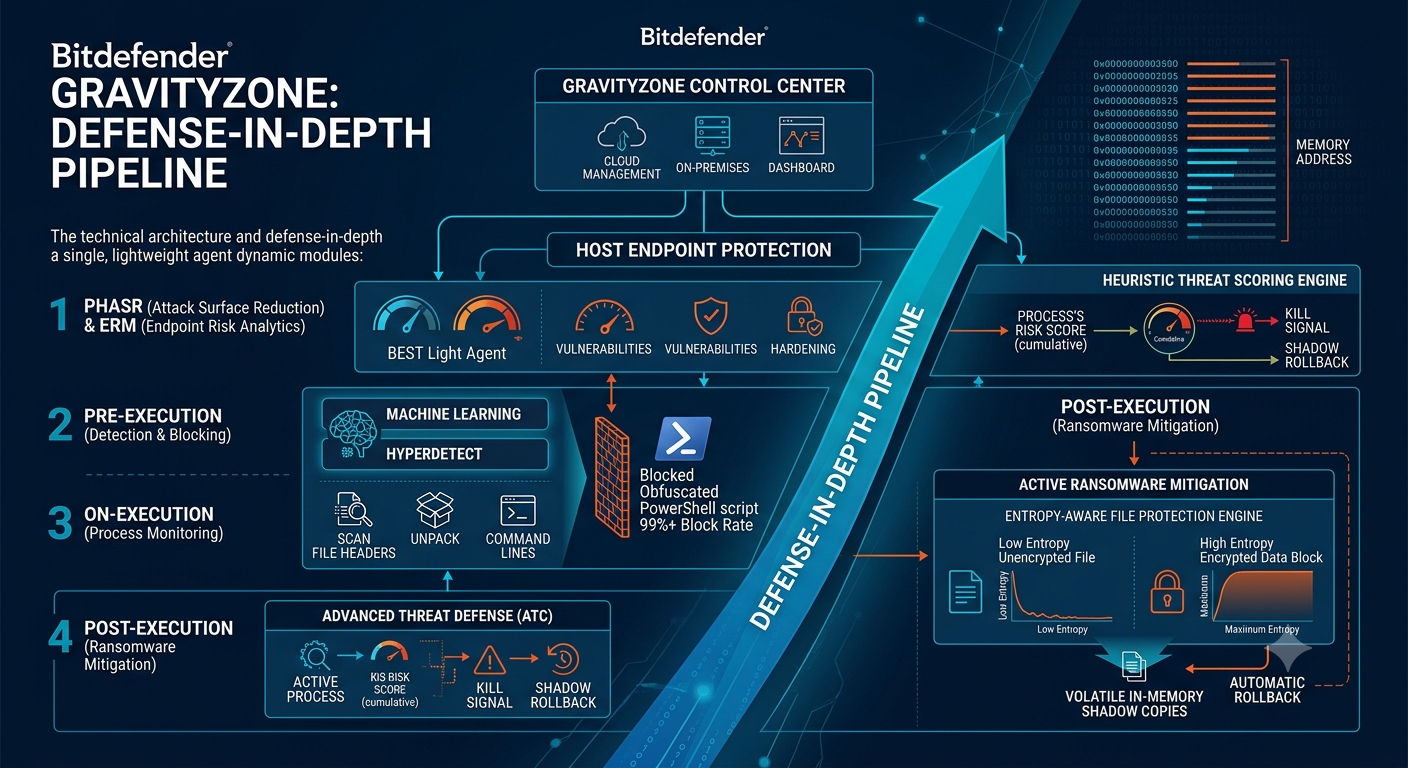
The Bitdefender GravityZone platform relies on a single lightweight enterprise agent (Bitdefender Endpoint Security Tools – BEST) deployed across hosts, managed via an cloud-native console or an on-premises Control Center instance.
                 +--------------------------------------+
                 |      GravityZone Control Center      |
                 |     (Cloud / On-Premises Console)    |
                 +------------------+-------------------+
                                    |
            +-----------------------+-----------------------+
            |                                               |
            v                                               v
+-----------------------+                       +-----------------------+
|  Host Endpoint A      |                       |  Host Endpoint B      |
|  [BEST Light Agent]   |                       |  [BEST Light Agent]   |
|                       |                       |                       |
| +-------------------+ |                       | +-------------------+ |
| |  PHASR & ERM Engine| |                       | |  PHASR & ERM Engine| |
| +---------+---------+ |                       | +---------+---------+ |
|           |           |                       |           |           |
|           v           |                       |           v           |
| +-------------------+ |                       | +-------------------+ |
| | Advanced Threat   | |                       | | Advanced Threat   | |
| | Defense (ATC)     | |                       | | Defense (ATC)     | |
| +---------+---------+ |                       | +---------+---------+ |
|           |           |                       |           |           |
|           v           |                       |           v           |
| +-------------------+ |                       | +-------------------+ |
| | In-Memory / Shadow| |                       | | In-Memory / Shadow| |
| | Ransomware Mitig. | |                       | | Ransomware Mitig. | |
| +-------------------+ |                       | +-------------------+ |
+-----------------------+                       +-----------------------+
Rather than deploying disparate binary drivers for antivirus, Endpoint Detection and Response (EDR), Extended Detection and Response (XDR), and patch management, BEST utilizes a core driver framework with dynamic module execution.
This single-agent approach prevents driver conflicts, reduces memory footprints, and avoids Antimalware Scanning Storms in dense virtual machine environments (such as VDI clusters) by offloading CPU-heavy scanning tasks to dedicated Security Virtual Appliances (SVA).
Defense-in-Depth Pipeline
Bitdefender’s execution flow enforces protection across four sequential stages: Prevention, Protection, Detection, and Response.
| Stage | Security Layer | Key Mechanism | Operational Impact |
| 1. Hardening | Proactive Hardening & Attack Surface Reduction (PHASR) | Analyzes endpoint risk scores, user behaviors, and unpatched vulnerabilities. | Minimizes breach surface before execution. |
| 2. Pre-Execution | Machine Learning & HyperDetect | Scans file headers, dynamic unpackers, and obfuscated powershell scripts. | Blocks 99%+ of zero-day threats pre-launch. |
| 3. On-Execution | Advanced Threat Defense (ATC) | Real-time behavior monitoring using process monitoring heuristics. | Terminates malicious process threads mid-run. |
| 4. Post-Execution | Active Ransomware Mitigation | Detects entropy increases in write operations and restores files from real-time shadow copies. | Guarantees zero data loss without relying solely on Windows VSS. |
Core Technical Components
1. Advanced Threat Defense (ATC) & Process Monitoring
Bitdefender’s Advanced Threat Defense (ATC) operates on zero-trust execution principles. Rather than checking static signatures, ATC monitors active operating system processes using ring-3 user-mode dynamic link library (DLL) injection alongside ring-0 kernel callback routines.
Process Spawn -> DLL/Kernel Injection -> Heuristic Threat Scoring Engine
                                                     |
             +---------------------------------------+
             |                                       |
     [Score < Threshold]                     [Score >= Threshold]
             |                                       |
      Execution Allowed                    Process Tree Terminated
                                           Shadow Rollback Triggered
- System Calls Inspection: ATC tracks process activities such as registry key modifications, dropped executable files, code injection into remote process addresses (
CreateRemoteThread), and anomalous outbound RPC/TCP connections. - Dynamic Risk Scoring: Every action assigns a cumulative risk score to the running process tree. When the cumulative threat score breaches a policy-defined threshold, the ATC engine issues an immediate kill signal to the process hierarchy.
2. Real-Time Ransomware Mitigation & In-Memory Shadow Backups
Traditional ransomware defenses rely heavily on Windows Volume Shadow Copy Service (vssadmin). However, modern ransomware strains routinely purge shadow copies prior to payload detonation using commands like:
PowerShell
vssadmin.exe delete shadows /all /quiet
Bitdefender overcomes this limitation through an entropy-aware file protection engine:
- Entropy Calculations: As processes request file write access, Bitdefender calculates the mathematical randomness (entropy) of the incoming data block. Unencrypted text or application files exhibit lower entropy, while encrypted data blocks demonstrate high entropy approaching maximum randomness ($H \approx 8.0$).
- Volatile In-Memory Shadow Copies: If an untrusted process initiates high-entropy write requests across multiple user documents, Bitdefender automatically creates real-time, isolated encrypted buffer copies in protected system storage before the write operation reaches the physical storage controller.
- Automatic Rollback: Once the malicious process is blocked and isolated, Bitdefender automatically restores the impacted files from its secure buffer.
3. HyperDetect & Machine Learning Models
Bitdefender incorporates locally trained local ML models alongside cloud-assisted threat intelligence networks. HyperDetect acts as a specialized pre-execution sandbox engine that analyzes suspicious files, command lines, and network connections prior to execution.
- Obfuscation Unpacking: Automatically decrypts and evaluates obfuscated script languages (including PowerShell, VBScript, and JavaScript).
- Exploit Defense: Detects attempt-patterns targeting buffer overflows, stack pivoting, and anti-detour bypass attempts directly within application memory allocation spaces.
Technical Advantages Over Standard Security Engines
- Ultra-Low Resource Overhead: By isolating heavy analytical computations (such as complex behavioral heuristic correlation and threat updates) through local kernel-level cache indexing and Cloud Threat Intelligence, endpoint CPU usage stays below 2% during full active monitoring.
- Resilience to Fileless Attacks: By continuously analyzing API calls in system memory (e.g., PowerShell invoking
VirtualAllocorWriteProcessMemory), Bitdefender deters fileless malware that runs entirely within physical RAM without touching the disk. - Unified Endpoint, Cloud, and Container Protection: Bitdefender extends its core GravityZone engine via native integrations into Linux container runtimes (Docker/Kubernetes), hypervisors (VMware ESXi, Nutanix AHV, Microsoft Hyper-V), and multi-cloud environments (AWS, Azure, GCP).
Conclusion
Bitdefender’s architectural strength relies on its proactive execution chain, behavioral entropy analysis, and centralized single-agent infrastructure. By integrating pre-execution hardening with automated post-execution ransomware rollback, the platform provides robust protection against modern cyber threats with minimal system performance impact
Also Read: The Complete Guide to 1Password: Security, Features, and Architecture – My Tech Blaze
Source: Stay Scam-Free with Bitdefender